Why Real-Time Cruise Alerts Transform Trip Planning

Booking your first cruise can feel overwhelming with prices, cabin choices, and ever-changing details across routes in the Mediterranean or Baltic Sea. For many young European travelers, the promise of real-time cruise alerts cuts through the confusion, letting you access deals and updates tailored to your preferences without constantly refreshing booking sites. This guide explains how modern smart technologies make cruise planning faster, safer, and more personalized, while clearing up misconceptions about alerts, so you can book with confidence and zero hassle.
Table of Contents
- Defining Real-Time Cruise Alerts And Myths
- The Main Types Of Cruise Alerts Explained
- How Cruise Alerts Work For Travelers
- Tech Features Supporting Real-Time Notifications
- Risks, Downsides, And Common Mistakes
- Comparing Alerts To Traditional Booking Methods
Key Takeaways
| Point | Details |
|---|---|
| Real-Time Alerts Offer Immediate Notifications | Real-time cruise alerts provide timely updates on price changes and availability to enhance decision-making and travel planning. |
| Set Specific Criteria for Alerts | Narrow your alert parameters to avoid overwhelm and ensure you receive relevant notifications that match your travel preferences. |
| Utilize Multiple Alert Types | Combining different categories of alerts (price, availability, promotions, operational) ensures comprehensive coverage of potential opportunities. |
| Avoid Alert Fatigue | Limit the number of alerts and review them strategically to prevent becoming desensitized to notifications and missing genuine deals. |
Defining Real-Time Cruise Alerts and Myths
Real-time cruise alerts are automated notifications that deliver price changes, availability updates, and personalized travel information instantly to your device the moment conditions matching your preferences occur. Unlike traditional email newsletters that arrive once daily or weekly, real-time alerts operate continuously, monitoring hundreds of cruise options across different lines, departure dates, and destinations. When a price drops, a cabin becomes available, or special promotions launch, you receive immediate notification rather than discovering the deal hours or days later. Think of it as having a personal travel scout watching 24/7 while you sleep, work, or enjoy your weekend.
The confusion around real-time alerts often stems from misconceptions about how they work and what they can deliver. Many first-time cruisers assume that real-time alerts require constant monitoring of your phone or that these systems are unreliable or overly intrusive. In reality, smart technology applications in cruise tourism have evolved significantly, using advanced data systems and artificial intelligence to distinguish between genuinely relevant changes and minor fluctuations. A real alert isn’t spam. It’s only triggered when your specific criteria are met—whether that’s a price reduction of 10 percent or more, a specific cabin type becoming available, or a promotion matching your travel window.
Another common myth suggests real-time alerts are purely for price tracking. They actually serve multiple functions beyond cost savings. Alerts can notify you about schedule changes, onboard experiences you registered interest in, cabin upgrades becoming available, or even safety-related updates during your voyage. Some systems integrate point-of-care diagnostics and health monitoring to keep passengers informed about health protocols, though this varies by cruise line and destination. The key distinction between real-time alerts and passive information updates is the proactive nature—you’re not hunting for information. The system brings relevant updates directly to you based on what matters for your specific trip.
Pro tip: Set up your alerts with narrow, specific criteria rather than broad parameters. Instead of watching all Mediterranean cruises, track departures from a specific port in a specific month with your preferred cabin type. This prevents alert fatigue while ensuring every notification represents a genuine opportunity worth considering.
The Main Types of Cruise Alerts Explained
Cruise alerts fall into several distinct categories, each serving different purposes for your trip planning and onboard experience. Understanding these types helps you configure your alert settings strategically so you receive notifications that matter most. The main categories include price alerts, availability alerts, promotion alerts, and operational alerts—each with specific triggers and timing.
Price alerts notify you when fares drop on sailings matching your preferences. These track per-person pricing across cabin types and departure dates, allowing you to set minimum discount thresholds before you receive notifications. Availability alerts trigger when specific cabin categories become open on previously full sailings, cabin locations you prefer become available, or when your desired sailing opens booking windows. Promotion alerts inform you about special offers, flash sales, onboard credit packages, or early-bird discounts relevant to your selected cruises. Operational alerts cover schedule changes, port modifications, itinerary adjustments, or weather-related updates affecting your specific sailing. On a broader scale, cruise lines maintain multiple alert code systems for onboard situations, though these typically remain internal unless they affect passengers directly.
Beyond these consumer-facing alerts, cruise operators maintain comprehensive alert systems for maritime operations. These include major ship-wide alarms covering emergency scenarios, fire detection, abandon-ship protocols, and collision warnings. While you won’t actively monitor these operational systems, understanding they exist provides context for safety briefings and crew communications during your voyage. When booking through platforms offering real-time alerts, you’re primarily interacting with the first four consumer alert types—the ones directly connected to your booking decisions and travel experience.
The best approach combines multiple alert types strategically. Set price alerts with reasonable discount percentages to avoid notification overload, enable availability alerts if you have flexibility on cabin location, and activate promotion alerts only during your active booking window. This layered approach means you stay informed about genuine opportunities while avoiding alert fatigue from minor fluctuations or irrelevant changes.
Below is a summary of the main types of cruise alerts and what each offers travelers:
| Alert Type | What It Tracks | Example Notification |
|---|---|---|
| Price Alert | Fare reductions matching your criteria | “Balcony cabin now $400 off” |
| Availability Alert | Newly available cabins or sailings | “Suite just opened for July date” |
| Promotion Alert | Limited-time deals and bonuses | “50% off deposits this weekend” |
| Operational Alert | Schedule or itinerary changes | “Port change: Now docking in Nassau” |
Pro tip: Create separate alert profiles for different trip scenarios—one for flexible weekend getaways with aggressive price tracking, another for specific anniversary or vacation week plans where cabin location matters more than price drops.
How Cruise Alerts Work for Travelers
Cruise alerts operate through a combination of data collection, intelligent filtering, and targeted notification delivery. Behind the scenes, booking platforms monitor thousands of cruise inventories continuously, checking for changes that match your specific criteria. When you set up an alert, you’re essentially creating a digital filter that scans against real-time databases. The system compares current prices, availability, and promotions against your preferences every few minutes or hours depending on the platform’s update frequency. Once a match occurs, the notification travels directly to your phone, email, or app notification center within minutes of the change occurring.
The technical backbone relies on what’s called smart technology integration, which uses artificial intelligence and data analytics to distinguish between noise and genuine opportunities. Rather than bombarding you with every single price fluctuation, advanced systems learn your patterns and only trigger alerts when meaningful changes occur. If you set a price alert for 15 percent off, the system ignores 2 percent dips and waits for substantial drops. This filtering prevents alert fatigue while ensuring you catch real deals. Personalized notifications through connected devices work seamlessly across your smartphone, tablet, and smartwatch, allowing you to stay informed regardless of where you are or what you’re doing.
When you receive a cruise alert, what you’re actually seeing is the result of automated processes working simultaneously across multiple data points. Your alert triggered because the system found a match, verified the information remained accurate in real-time, and determined it met your thresholds. This happens faster than you could manually check the booking site yourself. Some modern platforms even incorporate additional data streams like seasonal trends, historical pricing patterns, and competitor rates to identify when a price represents genuine value versus typical market fluctuation. Health and safety monitoring systems on cruise ships similarly use real-time detection to notify passengers about important onboard information, though these operate separately from booking alerts.
The timing of alert delivery matters significantly for your booking decisions. Receiving notification instantly means you can act while inventory remains available and prices haven’t shifted again. This immediacy is what sets real-time alerts apart from daily deal emails or weekly roundups. Understanding why mobile booking matters for travelers helps explain why most alert platforms prioritize mobile delivery—you need access anywhere, and mobile apps deliver notifications faster than email ever could.
Pro tip: Enable push notifications for your cruise booking app but customize which alert types send notifications versus email digests. Set price and availability alerts to push notifications for immediate action, while promotion alerts can go to email since they don’t require immediate decisions.
Tech Features Supporting Real-Time Notifications
Real-time cruise alerts depend on several interconnected technologies working simultaneously behind the scenes. The foundation starts with cloud computing infrastructure, which processes massive amounts of cruise inventory data from multiple sources simultaneously. This cloud-based architecture allows booking platforms to scale up or down based on demand, ensuring alerts remain fast and reliable whether you’re booking during peak season or a quiet Tuesday afternoon. Cloud systems also enable data to sync across your devices instantly, so an alert reaching your phone simultaneously updates your tablet and smartwatch without lag.
Artificial intelligence and machine learning form the decision-making layer of alert systems. These technologies analyze historical pricing patterns, seasonal trends, competitor rates, and your personal browsing behavior to determine which price changes warrant notifications versus which ones represent normal market fluctuation. Rather than alerting you to every single $5 drop, AI learns that you typically ignore minor changes but respond to double-digit percentage reductions. Smart cruise ecosystems integrate big data platforms with machine learning algorithms to deliver personalized alerts that feel specifically tailored to your travel preferences and booking patterns. The system becomes smarter the more you use it, gradually understanding which types of offers actually interest you versus which ones you consistently ignore.
Internet of Things (IoT) sensors and satellite communications enable real-time data collection across entire cruise fleets. While these technologies primarily support onboard operations, they also feed data into booking platforms about ship status, port schedules, and operational changes. When a sailing gets delayed due to weather, IoT systems detect this immediately and trigger alerts to passengers with bookings on that sailing. Integrated technologies including IoT sensors and automation collectively monitor ship operations and environmental conditions, ensuring passengers receive immediate notification about any factors affecting their voyage.
The notification delivery itself relies on push notification technology and API integrations that create direct communication channels between booking platforms and your devices. When an alert triggers, it doesn’t wait in a queue or batch with other messages. Instead, it travels immediately through direct connection protocols, arriving on your phone within seconds of the system identifying a match. This direct delivery system prioritizes alert messages over regular app traffic, ensuring time-sensitive information reaches you instantly even during high-traffic periods.
Pro tip: Check your phone’s notification settings to ensure cruise booking apps have permission for time-sensitive notifications. Many phones categorize these separately from regular notifications, and you want cruise alerts classified as time-sensitive so they bypass do-not-disturb mode and sound immediately.
Risks, Downsides, and Common Mistakes
Alert fatigue ranks as the most significant downside of real-time cruise notifications, and it catches most first-time users off guard. When you set up too many alerts with loose parameters, your phone becomes a constant buzzing reminder of cruise options rather than a helpful travel planning tool. This happened to Royal Caribbean users when app notification glitches sent repeated test alerts to thousands of customers, frustrating users and eroding trust in the system. The problem isn’t alerts themselves. The problem is over-notification. If you’re receiving 20 alerts daily, you stop reading them. Your brain treats them as background noise, and you might actually miss the genuinely exceptional deal buried in the avalanche of messages.
Another common mistake involves setting alert criteria too broadly. Many travelers mistakenly believe casting a wide net increases their odds of finding deals. Setting alerts for every cruise line, every departure port, every cabin type, and every month creates chaos. You end up tracking 500 potential cruises instead of focusing your decision-making on 10 realistic options matching your actual travel needs and budget. This scattered approach wastes your decision-making energy and makes it harder to recognize actual value when it appears. Additionally, some platforms have cyber vulnerabilities and data security concerns associated with real-time alert systems collecting and transmitting your personal travel preferences continuously. Before enabling alerts on any platform, review their privacy policy and data protection practices to understand what information they’re collecting and how they’re protecting it.
Over-reliance on alerts can also delay decision-making at critical moments. Some travelers become paralyzed waiting for alerts about a sailing that’s actually already gone on sale at reasonable rates. You might miss booking opportunities because you’re waiting for an alert about a price drop that never materializes. Real-time alerts work best as a tool that informs your decisions, not as a substitute for active decision-making. Set reasonable alert parameters, check them daily or every few days rather than obsessively throughout the day, and make booking decisions based on your actual travel timeline and budget rather than chasing every marginal price improvement.
Pro tip: Set a maximum of three to five specific alert profiles and review them only once daily during a designated time window rather than checking constantly throughout the day, which prevents alert fatigue while maintaining your competitive advantage in catching genuine deals.
Comparing Alerts to Traditional Booking Methods
Traditional cruise booking methods typically involve manually visiting cruise line websites, calling travel agents, or browsing travel agency storefronts to check prices and availability. This approach requires active effort from you—you’re the one monitoring prices, remembering to check back periodically, and hoping you catch deals before they disappear. The process feels reactive because it is. You wait for promotional emails, scan websites when you have time, and make decisions based on whatever information you encounter during your browsing sessions. With traditional methods, you’re essentially hunting for information rather than having information delivered to you strategically.
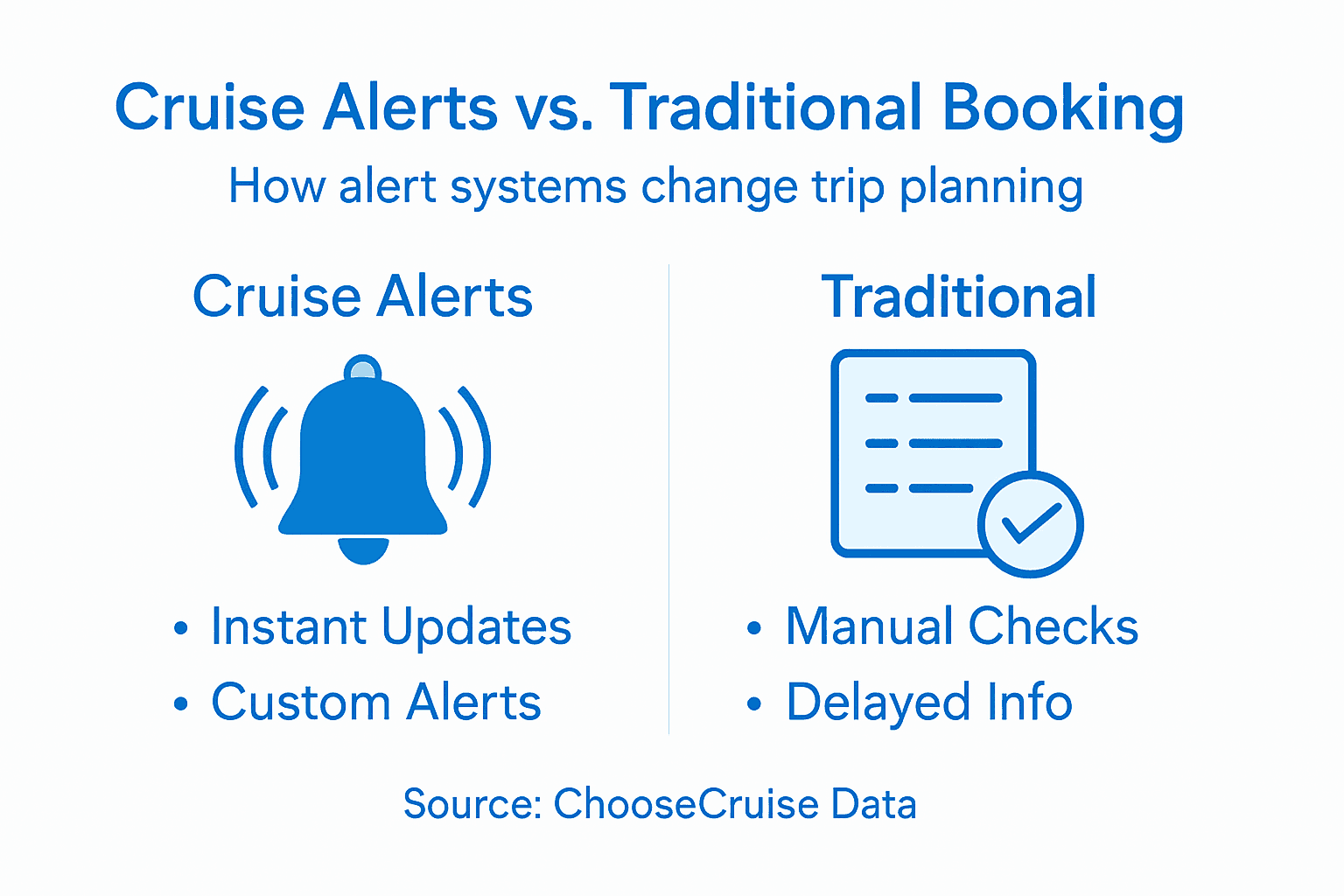
Real-time alerts flip this dynamic entirely. Instead of you checking cruise sites multiple times weekly, the system checks thousands of sailings continuously and notifies you only when conditions match your criteria. The difference in effort is dramatic. Traditional booking might require 10 to 15 manual price checks over several weeks to find a good deal. Real-time alerts accomplish the same task through 200 automated checks daily without requiring any action from you. Real-time alerts enhance traveler decision-making by providing up-to-date information and dynamic offers compared to static traditional booking methods that rely on outdated information or memory. When you finally receive an alert, you’re viewing current data from minutes ago, not information that might have changed since yesterday.
Convenience represents another significant advantage. Traditional methods require you to be at a computer or phone with internet access during business hours if you want to speak with a travel agent. Real-time alerts work 24/7, sending notifications whether you’re sleeping, working, or traveling. You can act on alerts immediately from your smartphone from anywhere in the world. Online real-time booking systems provide greater convenience and accessibility compared to traditional phone or in-person methods, reducing human error and eliminating the delays associated with coordinating availability between you and a travel agent. Additionally, alerts eliminate miscommunication. When a travel agent tells you about a price, you’re hearing information delivered through memory and verbal explanation. When you receive an alert, you’re looking at exact prices, specific cabin details, and precise departure dates directly from the booking system.
The trade-off is that alerts require initial setup and occasional adjustments as your preferences change. Traditional methods let someone else handle these logistics, but they also mean you’re paying commission fees or missing deals that fall outside their monitoring scope. Alerts put you in control but require basic decision-making about what factors matter most for your trip.
Here’s a side-by-side look at how real-time cruise alerts compare to traditional booking methods:
| Factor | Real-Time Cruise Alerts | Traditional Booking |
|---|---|---|
| Information Access | Immediate, automated delivery | Manual, user-initiated search |
| User Effort | Minimal once set up | Frequent monitoring required |
| Timing Advantage | Act instantly on deals | May miss time-sensitive offers |
| Customization | Highly personalized alerts | Limited to agent knowledge or website filters |
| Potential Downsides | Alert fatigue, data privacy | Missing deals due to delayed checks |
Pro tip: Combine alerts with strategic early booking timing for optimal results—set up alerts when you first start considering a cruise, which typically gives you 3 to 6 months of price tracking before you need to decide.
Take Control of Your Cruise Planning with Real-Time Alerts
The article reveals the frustration travelers face with alert fatigue and missed deals when relying on scattered or overly broad notifications. If you want to avoid overwhelming alerts and gain truly personalized, real-time cruise offers that match your exact preferences, ChooseCruise is made for you. We understand that setting up smart, specific criteria is key to success. Our platform uses advanced AI-powered recommendations and real-time price tracking to deliver only the most relevant updates directly to your devices. This means you save time, reduce stress, and never miss exceptional deals.
Experience the future of cruise booking by visiting ChooseCruise today. Get tailored cruise alerts designed to work with your lifestyle and interests so you can focus on what matters—enjoying your trip. Don’t wait until prices change or cabins fill up. Start your smarter cruise search now and take advantage of a seamless, mobile-friendly booking process crafted for travel-savvy people just like you.
Frequently Asked Questions
What are real-time cruise alerts?
Real-time cruise alerts are automated notifications that inform you of price changes, availability updates, and personalized travel information related to cruises that match your preferences. Unlike traditional email newsletters, these alerts provide immediate updates directly to your device.
How do I set up real-time cruise alerts?
You can set up real-time cruise alerts through various booking platforms by entering your specific criteria, such as desired cabin type, departure port, and travel dates. This allows the system to monitor and notify you of relevant changes automatically.
What types of alerts can I receive?
You can receive different types of alerts, including price alerts for fare reductions, availability alerts for newly opened cabins, promotion alerts for special deals, and operational alerts for changes to your sailing’s schedule or itinerary.
How do real-time alerts compare to traditional booking methods?
Real-time alerts provide immediate, automated notifications based on your criteria, requiring minimal user effort. In contrast, traditional booking methods involve manual searching and tracking, which can lead to missing time-sensitive opportunities. Real-time alerts allow you to act quickly when deals arise.
Recommended
Related reading
7 Smart Ways to Save on Cruises for Modern Travelers
Discover 7 smart ways to save on cruises with easy, practical tips designed for today’s digital cruise travelers. Learn to maximize value and minimize costs.
Understanding Why Choose River Cruises for Travel Fun
Discover why choose river cruises as your next adventure. Explore their benefits, unique experiences, and how they enhance travel enjoyment.
Understanding the Best Cruise Lines for Beginners
Discover the best cruise lines for beginners, understanding what they offer and why they matter for first-time cruisers.