Cruise Line Classes Explained: A First-Timer’s Guide
TL;DR:
- Cruise line classes are categorized by ship size, service level, and the experience offered. Choosing the right category aligns your trip with your preferences, ensuring satisfaction.
Cruise line classes are defined categories that group ships by size, service level, and the type of experience they deliver. Understanding these categories is the fastest way to avoid booking the wrong trip. The cruise industry organizes ships into nine main types, each serving a distinct traveler profile, from families seeking resort-style entertainment to adventurers chasing remote coastlines. Matching your vacation goals to the right class saves money, prevents disappointment, and turns a confusing booking process into a confident decision. ChooseCruise exists precisely to make that match easier.
What are the main cruise line classes explained?
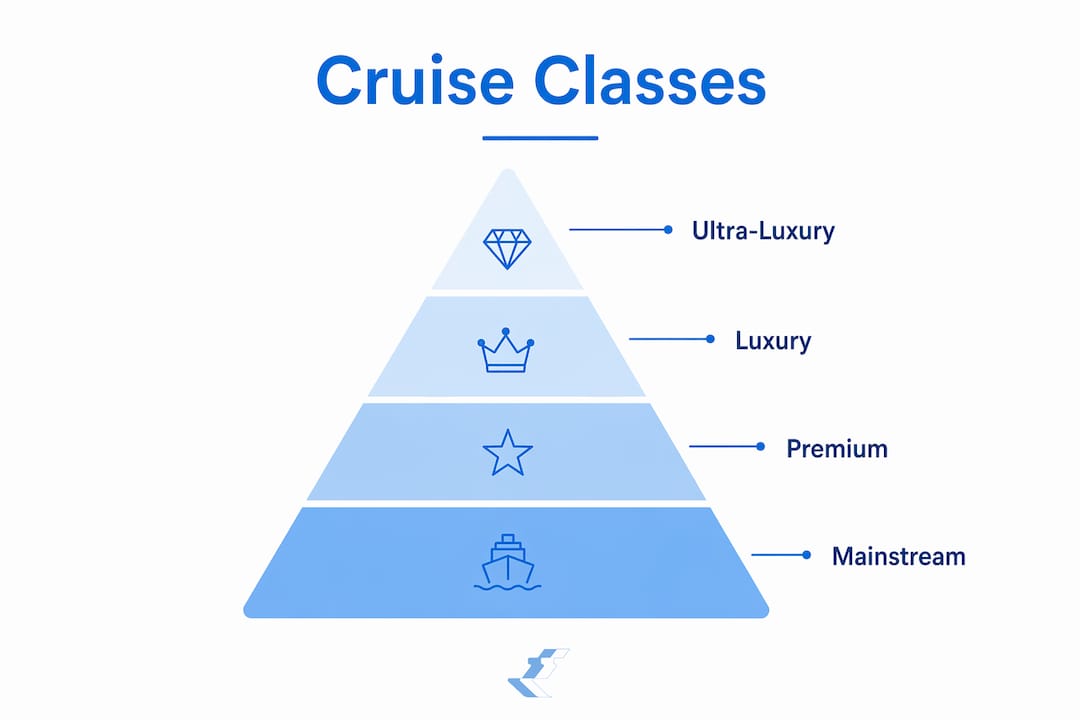
Cruise line categories are driven by business models that shape crew-to-passenger ratios, service quality, and ship layout. Price is a byproduct of those choices, not the defining factor. The four main cruise categories are mainstream, premium, luxury, and ultra-luxury, each targeting a different traveler type.

Mainstream cruise lines operate the largest ships and target families and first-time cruisers. These vessels carry 3,000 to 6,500+ passengers and pack in Broadway-style shows, waterslides, multiple dining venues, and onboard shopping. The experience feels closer to a floating resort than a traditional voyage. Pricing is broad, and the cabin class you choose within the ship matters as much as the line itself.
Premium cruise lines sit one step above mainstream. Ships are slightly smaller, service is more attentive, and dining quality improves noticeably. These lines attract experienced travelers who want comfort without paying for full luxury. The onboard atmosphere is quieter, and itineraries often include more varied ports.
Luxury and ultra-luxury cruise lines operate small ships carrying 200–700 passengers with highly personalized service. Crew-to-passenger ratios are far higher than mainstream lines, meaning staff genuinely know your name and preferences by day two. All-inclusive pricing is standard, covering drinks, gratuities, and often shore excursions. These lines target experienced cruisers who prioritize quality over quantity.
- Mainstream: 3,000–6,500+ passengers, resort features, broad pricing, ideal for families
- Premium: 1,000–3,000 passengers, better dining and service, suits repeat cruisers
- Luxury: 200–1,000 passengers, personalized service, all-inclusive, suits discerning travelers
- Ultra-luxury: Under 300 passengers, yacht-like atmosphere, highest crew ratios, suits experienced cruisers
Pro Tip: When comparing lines, look up the crew-to-passenger ratio before you look at the price. A ratio of 1:1.5 or better signals genuinely attentive service, regardless of the line’s marketing claims.
How does cruise ship size affect your onboard experience?
Gross Tonnage (GT) is the standard measure of a ship’s internal volume and is a better indicator of spaciousness than passenger count alone. Higher GT with the same number of passengers means more space per guest, which directly affects how crowded corridors, pools, and dining rooms feel. Ship age and renovation history also influence the experience, but GT is the most reliable starting point.
The industry uses four size tiers:
| Size Class | Gross Tonnage | Typical Passengers | Best For |
|---|---|---|---|
| Small/Boutique | Under 30,000 GT | 50–500 | Expedition, luxury, river |
| Mid-Size | 30,000–70,000 GT | 500–2,000 | Premium, destination-focused |
| Large | 70,000–120,000 GT | 2,000–3,500 | Premium, mainstream |
| Mega | Over 120,000 GT | 3,500–7,600 | Mainstream, resort-style |
Royal Caribbean’s Icon Class ships illustrate the mega tier clearly. Icon Class vessels reach 248,663 GT with a maximum of 7,600 passengers, while the older Vision Class sits at around 73,817 GT with 2,700 passengers. The difference in onboard atmosphere between those two ships is dramatic, even within the same cruise line.
Mega-ships deliver the widest range of onboard amenities: multiple pools, dozens of restaurants, casinos, rock-climbing walls, and full entertainment venues. The trade-off is that these ships dock at major ports only, and embarkation and disembarkation can consume hours of your day. Smaller ships visit unique ports that mega-ships physically cannot reach, and they spend longer in each destination because tendering and crowd management take far less time.
Pro Tip: If your priority is the destination rather than the ship itself, choose a vessel under 70,000 GT. You will spend more time ashore and less time waiting in line.
For travelers still deciding between ship types, the 7 types of cruise ships guide on ChooseCruise breaks down each category with practical examples.
What specialized cruise types exist beyond standard ocean cruises?
The cruise industry now serves nine distinct traveler profiles, and several of those sit well outside the mainstream ocean cruise model. Knowing these options prevents you from defaulting to a megaship when a river cruise or expedition voyage would suit you far better.
- Expedition cruises: Small ships carrying 50–500 passengers, designed for remote destinations like Antarctica, the Galápagos, or the Norwegian fjords. Onboard amenities are minimal. The destination is the entire point.
- River cruises: Ships carry 100–200 passengers along inland waterways in Europe, Asia, and the Americas. These vessels dock in city centers, often within walking distance of major landmarks. No sea days, no seasickness.
- Repositioning cruises: Ships moving between seasonal homeports offer unusually long itineraries at low prices. A transatlantic crossing from Miami to Barcelona, for example, covers ports that standard Caribbean loops never touch.
- Theme cruises: Mainstream or mid-size ships chartered for specific interest groups, from jazz festivals to wellness retreats to culinary programs. The ship and itinerary are secondary to the shared experience onboard.
- World cruises: Voyages lasting 90–180 days that circumnavigate the globe. These attract retired travelers or remote workers with extended flexibility. Pricing reflects the duration, but per-day costs are often lower than luxury short cruises.
- Small-ship sailing: Sailing yachts and motor yachts carrying under 100 guests, focusing on the Greek islands, the Caribbean, or Southeast Asia. The experience is intimate and flexible, with itineraries that adjust based on weather and passenger interest.
The key trade-off across all specialty types is clear. Fewer onboard amenities mean more authentic destination access. If you board an expedition ship expecting a casino and a spa, you will be disappointed. If you board it expecting to kayak past glaciers, you will be transformed.
For travelers curious about niche experiences, themed cruise options have expanded significantly in 2026, covering interests that mainstream lines rarely address.
How to choose the right cruise line class for your trip
Matching your vacation priorities to the right class requires honest answers to a few direct questions. Work through these before you compare prices.
-
Define your primary goal. Are you there for the ship or the destination? If onboard entertainment, nightlife, and variety matter most, a mainstream megaship delivers the best value. If you want to spend maximum time exploring ports, a mid-size or small ship wins every time.
-
Set your comfort baseline. Crowded pools and long buffet lines bother some travelers and don’t register for others. If personal space matters to you, prioritize ships with a higher GT relative to passenger count. The space-to-passenger ratio is a concrete metric you can compare across ships before booking.
-
Match the itinerary length to your travel style. Short cruises of 3–5 nights suit first-timers testing the format. Longer voyages of 10–14 nights make sense once you know you enjoy the pace. World cruises and repositioning sailings require genuine flexibility in schedule and budget.
-
Understand what all-inclusive actually means. Mainstream lines advertise low base fares but charge separately for specialty dining, drinks, Wi-Fi, and shore excursions. Luxury lines bundle most of these costs upfront. The total spend often converges more than the headline price suggests.
-
Check the crew-to-passenger ratio. This single number predicts service quality better than any marketing description. Luxury lines typically run ratios of 1:1.5 or better. Mainstream lines often run 1:3 or higher. That gap shows up in every interaction onboard.
-
Read the itinerary port by port. A Caribbean cruise stopping at Nassau, Cozumel, and Labadee is a very different trip from one stopping at Dominica, Grenada, and Tobago. The class of ship often determines which ports are even accessible.
Travelers comparing multiple lines benefit from a structured approach. The cruise line comparison guide on ChooseCruise walks through each evaluation criterion with clear examples.
Key Takeaways
Cruise line classes are defined by ship size, service model, and target traveler type, and matching those factors to your personal priorities is the only reliable way to book the right trip.
| Point | Details |
|---|---|
| Classes reflect business models | Mainstream, premium, luxury, and ultra-luxury lines differ in crew ratios and service, not just price. |
| Gross Tonnage predicts spaciousness | Higher GT relative to passenger count means less crowding and a more comfortable experience. |
| Small ships access better ports | Vessels under 30,000 GT reach destinations that mega-ships cannot, with longer time ashore. |
| Specialty types serve niche travelers | Expedition, river, and theme cruises prioritize destination or shared interest over onboard amenities. |
| Total cost matters more than base fare | Luxury all-inclusive pricing often competes with mainstream fares once add-ons are counted. |
Why the “price equals quality” rule fails on cruise ships
The most persistent misconception about cruise classes is that a higher cabin price automatically means a better experience. It does not. Price alone does not define cruise line category. A suite on a mainstream megaship costs more than a standard cabin on a luxury small ship, but the overall experience on the luxury vessel will feel more personal, quieter, and more destination-focused.
I have seen first-time cruisers book the most expensive cabin on a 5,000-passenger ship and feel underwhelmed, while travelers in modest cabins on a 400-passenger expedition ship come back calling it the best trip of their lives. The ship’s class and size determine the atmosphere. The cabin determines your private comfort within that atmosphere. Both matter, but they answer different questions.
The other mistake I see constantly is treating all cruises as interchangeable. Mainstream megaships and luxury small ships are not the same product at different price points. They are fundamentally different holidays. A megaship is a destination in itself. A small expedition vessel is a vehicle to reach destinations. Deciding which one you actually want is the most important decision in the booking process, and it has nothing to do with budget.
My honest advice: ignore the marketing photography and read the ship’s GT, passenger count, and crew ratio instead. Those three numbers tell you more about your actual experience than any brochure ever will.
— Igor
Plan your cruise with ChooseCruise
Understanding cruise line classes gives you a real advantage when booking. The next step is finding the specific ship and itinerary that matches what you now know about your preferences.
ChooseCruise makes that process direct and fast. The platform offers real-time price tracking, AI-powered recommendations, and filters that let you sort by ship size, service level, and destination type. Whether you are looking for a short cruise deal to test the format or a longer voyage on a luxury small ship, ChooseCruise surfaces the options that fit your criteria without requiring you to dig through dozens of outdated listings. Compare and book cruise deals across all major classes and find the trip that actually matches your goals.
FAQ
What are the main cruise line classes?
The four main cruise line classes are mainstream, premium, luxury, and ultra-luxury. Each differs in ship size, crew-to-passenger ratio, service style, and pricing model.
How does ship size affect the cruise experience?
Ship size, measured in Gross Tonnage, directly affects crowding, port access, and onboard amenities. Mega-ships over 120,000 GT carry up to 7,600 passengers and offer the most facilities, while small ships under 30,000 GT access remote ports and provide a quieter atmosphere.
What is the difference between luxury and mainstream cruises?
Mainstream cruises target families with large ships, broad entertainment, and variable pricing. Luxury cruises offer all-inclusive fares, small ships carrying 200–700 guests, and crew-to-passenger ratios that deliver genuinely personalized service.
Are specialty cruise types like expedition or river cruises worth it?
Expedition and river cruises suit travelers whose priority is destination access over onboard entertainment. These ships carry 50–200 passengers, dock in smaller or city-center ports, and spend more time ashore than mainstream vessels.
How do I choose the right cruise class for my first trip?
Start by deciding whether the ship or the destination is your primary focus. Then check the crew-to-passenger ratio, Gross Tonnage relative to passenger count, and the total all-in cost before comparing headline fares.
Recommended
Related reading
6 Best Cruise Destinations 2026 for Smart First-Time Travelers
Discover the 6 best cruise destinations 2026 with expert tips for tech-savvy first-time travelers, including personalized advice for easier cruise booking.
Cruise Package Explained: Stress-Free Vacation Booking
Cruise package means bundled travel with accommodations, meals, entertainment, excursions. Learn the types, inclusions, pros, costs, and mistakes to avoid.
7 Smart Ways to Save on Cruises for Modern Travelers
Discover 7 smart ways to save on cruises with easy, practical tips designed for today’s digital cruise travelers. Learn to maximize value and minimize costs.