Cruise Port Tax Explained: Your 2026 Budget Guide

TL;DR:
- Cruise port tax is a mandatory fee covering docking, port services, and government charges collected from passengers. These fees vary by region, with high-cost areas like Alaska charging up to $40 per person per night. Passengers should verify and include these costs in their overall cruise budget to avoid surprises.
Cruise port tax is defined as a mandatory per-passenger fee that covers the cost of docking, port services, and government-mandated charges at every stop on your itinerary. These fees are not optional. Cruise lines collect them from passengers and pay them directly to port authorities, harbor pilots, customs agencies, and local governments. For first-time cruisers especially, port taxes often appear as a surprise line item on the final invoice. Knowing what they are before you book puts you in control of your actual vacation cost.
What is cruise port tax and what does it cover?
Cruise port tax is the industry’s umbrella term for a collection of fees that cover docking and port services, including harbor pilot charges, security costs, baggage handling, customs and immigration expenses, and infrastructure maintenance. The formal term you will see on booking invoices is “Port Expenses” or “Government Taxes and Fees.” Both phrases mean the same thing. Understanding this terminology helps you read your booking summary accurately.
These fees reflect real operational costs, not arbitrary add-ons. Every time a cruise ship enters a port, it requires a licensed harbor pilot to guide it safely in, a berth to dock at, security screening for thousands of passengers, and customs processing. Each of those services carries a price set by the port authority or the local government. The cruise line pays those bills and passes the cost directly to passengers.
Port taxes also fund broader infrastructure. Many ports use a portion of these fees for environmental compliance programs, terminal upgrades, and accessibility improvements. Some ports direct a share toward local community funds. The fees you pay at a Caribbean port in 2026 may partly fund the pier expansion you walk across to board your excursion.
Key components bundled into port taxes:
- Docking and mooring fees: Charged by the port authority for the ship’s berth
- Harbor pilot charges: Mandatory licensed pilot fees for navigating the ship into port
- Security and customs fees: Passenger screening and immigration processing costs
- Head taxes: Per-passenger fees set by local or national governments
- Infrastructure and environmental levies: Maintenance and sustainability contributions
Pro Tip: Ask your cruise line for an itemized breakdown of port expenses before final payment. Most lines provide this on request, and it helps you spot any new regional taxes added after your initial quote.
How do port fees vary by region and itinerary?
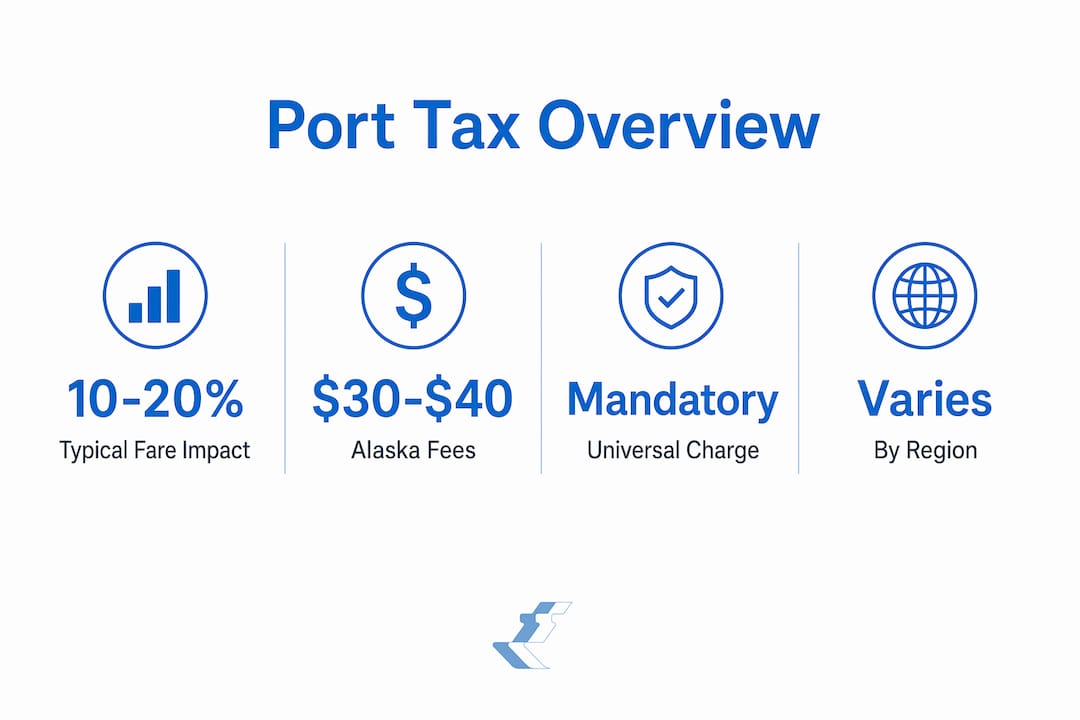
Port fees vary significantly by region, and the differences can add up to hundreds of dollars across a multi-port itinerary. Alaskan cruise ports are among the most expensive, with charges often reaching $30–$40 per person per night. Mediterranean ports average $10–$20 per person per night. Caribbean ports fall somewhere in between, though they vary widely depending on the specific island and its government policies.

To put that in concrete terms: two passengers on a seven-night Caribbean cruise might pay the equivalent of $360 total in taxes and fees, compared to roughly $300 in the Mediterranean for a similar itinerary. That $60 difference may seem small, but it compounds when you factor in longer voyages or premium itineraries with multiple high-cost ports.
Why smaller ports often cost more
Smaller or less visited ports frequently carry higher per-passenger fees because the total operating costs are spread across fewer passengers. A busy Caribbean hub like Nassau processes thousands of passengers daily, spreading fixed costs widely. A boutique port in the Great Lakes or a remote Norwegian fjord stop handles far fewer ships, so each passenger absorbs a larger share of the port’s fixed expenses.
Sustainability and seasonal taxes
Sustainability taxes are now a standard feature at high-traffic destinations. Greek islands charge seasonal fees during peak months to manage tourist volume. Iceland applies a daily port fee specifically designed to offset environmental impact. These charges are sometimes only triggered when a passenger actually disembarks. If you stay aboard at a port with a sustainability levy, you may avoid that specific charge entirely.
New government policies continue to reshape the fee landscape. Mexico’s non-resident cruise tax and updated Greek port fees are recent examples of evolving regulations that directly affect what passengers pay. Travelers booking itineraries that include these destinations after the effective dates of new policies will see the charges integrated into their taxes and fees line item automatically.
| Region | Typical per-person nightly fee | Notable factors |
|---|---|---|
| Alaska | $30–$40 | High pilot fees, remote infrastructure |
| Mediterranean | $10–$20 | Seasonal sustainability taxes in Greece |
| Caribbean | Varies widely | Head taxes differ by island government |
| Iceland | Variable | Daily environmental port levy |
| Great Lakes | Higher per passenger | Low passenger volume, shared fixed costs |
How are port fees calculated and billed?
Cruise lines collect port taxes from passengers and remit them to port authorities. Passengers cannot negotiate directly with ports, and fees are standardized per passenger regardless of cabin category or age. A passenger in an interior cabin pays the same port tax as one in a suite. That standardization is worth knowing because it means port fees do not scale with the price of your ticket.
Port fees are usually included in the total fare but itemized separately as “Port Expenses” or “Government Taxes and Fees” on your booking summary. Some cruise lines display these charges upfront during the search process. Others reveal them only at the checkout stage. Always verify the full fee total before final payment to avoid surprises.
What to check before you confirm your booking:
- Confirm the total “Taxes, Fees, and Port Expenses” line on your invoice
- Check whether any new regional taxes apply to your specific ports of call
- Note the fee amount per person so you can calculate the total for your travel group
- Review the cruise line’s policy on fee adjustments if itinerary changes occur
Pro Tip: Screenshot your booking summary showing the full taxes and fees breakdown at the time of purchase. If the itinerary changes later, you will have a clear record to reference when requesting a refund.
Refunds when ports are skipped
Passengers typically receive a refund or onboard credit for port fees when a ship skips a port due to weather or operational issues. The refund is not always automatic. Passengers need to verify with guest services that the credit has been applied. Keeping a record of your original fee breakdown makes this process straightforward.
How port taxes affect your cruise budget
Port charges typically amount to 10–20% of a cruise’s base fare. That percentage can climb higher on itineraries that include Alaska, Iceland, or other high-cost port regions. On a $1,500 base fare per person, that means budgeting an additional $150–$300 before you account for gratuities, excursions, or onboard spending.
Understanding port fee calculations helps travelers compare itineraries accurately. A cruise advertised at a lower base price may carry significantly higher port fees depending on the destinations. Always compare the total cost, not just the headline fare.
Here is a practical approach to building port fees into your cruise budget:
- Get the all-in price first. Request or calculate the total fare including taxes and fees before comparing cruises. A lower base price with high port fees can cost more than a slightly pricier itinerary with modest fees.
- Multiply by your group size. Port fees are charged per person. A family of four on an Alaskan cruise at $35 per person per night pays $980 in port fees alone on a seven-night trip.
- Factor in sustainability taxes. If your itinerary includes Greek islands or Iceland, budget for seasonal levies. Staying aboard at those stops avoids the disembarkation charge.
- Track itinerary changes. Cruise lines occasionally swap ports. When that happens, the fee for the dropped port should be refunded. Monitor your booking account and follow up with guest services if the credit does not appear.
- Use total-cost comparison tools. Platforms like ChooseCruise display full cruise pricing including taxes and fees, making it easier to compare itineraries on equal footing rather than base fare alone.
For first-time cruisers, the budget planning process should always start with the all-in number. Port fees are not negotiable, but knowing them in advance means no unpleasant surprises at checkout or on your onboard account.
Key Takeaways
Cruise port taxes are mandatory, per-passenger fees that cover real operational costs and typically add 10–20% to the base cruise fare, making them a critical line item in any accurate cruise budget.
| Point | Details |
|---|---|
| Port tax definition | Mandatory fees covering docking, pilots, customs, security, and government levies at each port |
| Regional cost differences | Alaska runs $30–$40 per person per night; Mediterranean averages $10–$20 per person per night |
| Billing transparency | Fees appear as “Port Expenses” or “Government Taxes and Fees” on your booking invoice |
| Refund eligibility | Passengers can claim refunds or onboard credits when a port is skipped, but must verify manually |
| Budget impact | Port fees typically equal 10–20% of the base fare and scale with group size and itinerary length |
Why I think most cruisers underestimate port fees until it’s too late
The most common complaint I hear from first-time cruisers is not about the food or the cabin size. It is about the final price being higher than expected. Port fees are almost always the culprit. Cruise marketing leads with the base fare because it is the most attractive number. The taxes and fees line gets buried in the booking flow, and many travelers only notice it at the payment screen.
What frustrates me about this pattern is that it is entirely avoidable. Port fees are not hidden in any legal sense. They are disclosed. But they are disclosed late, in small print, after a traveler has already invested time comparing itineraries. That timing creates sticker shock, and sticker shock erodes trust.
The sustainability tax trend is worth watching closely. Greek islands, Iceland, and Mexico have all introduced or updated port levies in recent years. These are not temporary experiments. Governments at high-traffic destinations are increasingly using cruise passenger fees as a tool for managing overtourism and funding environmental programs. Travelers who understand this context will not be surprised when they see a new line item on a future booking.
My practical advice for first-time cruisers: treat port fees the same way you treat airline baggage fees. They are not optional, they scale with your group, and they vary by route. Build them into your budget from day one, not as an afterthought. The traveler who does this arrives at the pier relaxed. The one who ignores it arrives frustrated.
— Igor
Plan your cruise with full cost visibility on ChooseCruise
Booking a cruise without seeing the full price is like buying a flight without checking the baggage fee. ChooseCruise shows you the complete cruise fare including taxes, fees, and port expenses, so you compare itineraries on equal terms from the start.
The price drop tracker monitors fare changes across hundreds of itineraries, including shifts in the taxes and fees component when new port levies take effect. You can filter by region, departure port, and total budget, not just the base fare. For travelers who want to plan with confidence and avoid checkout surprises, ChooseCruise gives you the numbers that actually matter.
FAQ
What is cruise port tax exactly?
Cruise port tax is a mandatory per-passenger fee that covers docking, harbor pilot charges, customs, security, and government levies at each port of call. It appears on your invoice as “Port Expenses” or “Government Taxes and Fees.”
Do you pay port tax on every cruise?
Yes. Port taxes apply to every cruise itinerary because every port of call charges fees for the services and facilities the ship and its passengers use.
How much are port fees on a typical cruise?
Port fees typically equal 10–20% of the base cruise fare, though Alaskan itineraries can push that higher with per-person nightly charges reaching $30–$40.
Can you get a refund on port taxes if a port is skipped?
Passengers are generally entitled to a refund or onboard credit for port fees when a ship skips a port. The refund is not always automatic, so verify with guest services after any itinerary change.
Are sustainability taxes included in cruise port fees?
Yes. Environmental levies charged by destinations like Greek islands and Iceland are included in the taxes and fees component of your cruise fare. Some of these charges apply only when you disembark, so staying aboard at those stops may reduce your total fee.
Recommended
Related reading
6 Best Cruise Destinations 2026 for Smart First-Time Travelers
Discover the 6 best cruise destinations 2026 with expert tips for tech-savvy first-time travelers, including personalized advice for easier cruise booking.
Cruise Package Explained: Stress-Free Vacation Booking
Cruise package means bundled travel with accommodations, meals, entertainment, excursions. Learn the types, inclusions, pros, costs, and mistakes to avoid.
7 Smart Ways to Save on Cruises for Modern Travelers
Discover 7 smart ways to save on cruises with easy, practical tips designed for today’s digital cruise travelers. Learn to maximize value and minimize costs.