Cruise with Friends: How to Plan a Trip Everyone Enjoys
A cruise with friends works when you settle four things before you look at a single sailing: how many days everyone can take off, what each person will spend, what kind of ship suits the group, and how you will book the cabins. Get those right and the rest is the fun part. To compare sailings across cruise lines and watch prices while you decide, we built the ChooseCruise cruise search engine for exactly that stage.
This guide is written for first-timers and younger travelers who are organizing a group trip, often with one person acting as the unofficial planner.
TL;DR
- Agree on dates, budget and trip purpose in the group chat before browsing. Schedules and money are what break group trips, not ships.
- Pick 3 to 4 nights for a celebration or a first test, 5 to 7 nights for a mixed group, and longer only for destination-focused friends.
- Book all cabins in one sitting, on the same deck, and ask for the reservations to be linked so the group is recognized as traveling together.
- Budget the extras: Wi-Fi, drinks, specialty dining and excursions can add up faster than the fare.
- Track the fare on the sailing you choose, so the whole group books at a price everyone has seen.
Table of Contents
- Start with the questions that decide everything
- How long should a cruise with friends be?
- Match the ship and itinerary to the group
- Set a budget the whole group can live with
- Book the cabins together
- Staying in touch at sea: Wi-Fi and FaceTime
- A planning timeline for the group planner
- Find the sailing and watch the price with ChooseCruise
- Our perspective
- FAQ
- Sources
Start with the questions that decide everything
Most cruise-with-friends advice jumps straight to ships. The better order is to start with the people. A planning guide from a US cruise planner (published October 2026) lists what a group should settle before choosing a ship: where everyone lives, ages and mobility, available vacation time, budget comfort, desired activity level and the purpose of the trip (America’s Best Cruises’ group guide, referenced in the research). That list is worth copying into your chat as a checklist.
Two of those questions do most of the work.
How many days can everyone really spare? Coordinating time off is the hardest part of any friend trip. If one person can only take a long weekend, a 3-night sailing is your ceiling, and that is fine. Cruise lines run short itineraries from most major US coastal ports, from Boston and New York to Miami, Galveston, Seattle and Los Angeles.
What does “convenient” mean for this group? For some it is the lowest fare. For others it is a departure port they can drive to, or an itinerary without too many sea days. Name the priority out loud. If two friends want a bargain and two want a beach every day, you want to find that out in week one, not at the booking screen.
Then add the money question, which is the awkward one. Ask each person for a comfortable total, including flights to the port and spending onboard, not just the cruise fare. Write down the lowest number and plan to that. A group that plans to the most generous budget ends up with one friend quietly skipping dinners.
If you are new to cruising generally, our first-timer planning guide walks through the basics, and our group cruise planning checklist turns the group-specific steps into a list you can share.
How long should a cruise with friends be?
Length is the setting that most affects whether the trip feels relaxed or rushed. A rough guide, drawn from US cruise planning advice:
| Length | Best for | Watch out for |
|---|---|---|
| 3 to 4 nights | Birthdays, bachelor and bachelorette weekends, groups with limited time, anyone trying cruising for the first time | Little time to settle in; ports are quick |
| 5 to 7 nights | Mixed groups, first group trips, a balance of ship time and ports | Needs a full week of vacation for most people |
| 8 nights or more | Committed, destination-focused travelers | Harder to align schedules and budgets |
The 3-to-4-night and 5-to-7-night guidance follows America’s Best Cruises’ advice, summarized by CruiserHacks. One first-cruise guide also suggests that a 3 to 5 night sailing is a low-commitment way to test cruising, while a 7-night sailing suits people who are confident they will like it (EatSleepCruise, updated March 2026).
If your group includes people who have never cruised, a short sailing is the safer bet. You can compare current options by length on our pages for 3-day, 4-day, 7-day and 10-day cruises.
Match the ship and itinerary to the group
The biggest mistake first-time groups make is choosing a ship by price alone. One cruise guide argues that the composition of your group shapes the ideal cruise more than any other single factor. Its rule of thumb: if your friends are adventure and destination seekers, prioritize the itinerary; for everyone else, prioritize the ship (EatSleepCruise).
Ship size is the clearest example. A travel writer quoted by AARP says to know your personality: smaller, lower-key ships suit people who want a simple dinner and a drink before bed, while those who like many restaurants, casinos and live shows are better off on larger ships, which are also often less expensive (AARP’s smart guide to cruises, January 2024).
In practice:
- Party-minded or social groups usually want a big ship with lots of bars, shows and things to do after dark.
- Relaxed groups who mostly want to talk, eat well and see a few ports often do better on a smaller ship.
- Mixed groups do best with a ship that has enough variety that nobody has to follow the crowd. Variety in activities, entertainment and dining is the thing to look for.
For itinerary, think about what the group does together on land. A Caribbean or Mexican sailing suits groups that mostly want beach days. Alaska, usually about a week, suits friends who like hiking and kayaking. Shorter sailings from Boston suit fall foliage and seaside towns. These pairings come from Royal Caribbean’s friends planning guide.
Our excursion guide helps when the group splits on shore plans, which it almost always does at least once.
Set a budget the whole group can live with
Cruise fares are attractive for friend groups with different budgets because the fare typically covers your room, main dining, most onboard activities and nightly entertainment. Older ships usually cost less than the newest ones while visiting the same popular destinations (Royal Caribbean).
Cabin sharing is the biggest lever. Per-person pricing assumes two people per cabin. On Carnival, one cost guide estimates average fares of $100 to $130 per person per night for interior cabins and $140 to $190 for balcony cabins, taxes and port fees included, and notes that the first two guests pay full fare while additional guests in the same cabin pay a discounted rate (EatSleepCruise, updated January 2025). That makes a cabin for three or four friends cheaper per head, if you are comfortable with the space.
A simple worked example for a 7-night trip with the interior range above: at $100 to $130 per person per night, one person pays $700 to $910 for the week in fare. Those are estimates from one cost guide, so treat them as a starting point and check the actual sailing before you commit.
Then list the costs that are not in the fare. The group guide from a cruise planner (October 2026) flags specialty dining, premium drinks, spa treatments and private tours as the items that add up fast, and recommends talking about budget comfort before you sail (summarized in the research). Decide as a group:
- Who wants a drink package, and who does not?
- Is there one splurge dinner everyone will share?
- Will you book excursions together or separately?
- How will you split shared costs, such as a group Wi-Fi plan?
For a deeper look at saving, see our budget cruise booking steps and the first-timer budget workflow.
Book the cabins together
This is where group cruises go wrong in practice. Friends book on different days, prices shift, and suddenly you are on different decks. A worked example of a 12-person group suggests a sensible routine (CruiserHacks, November 2026):
- Agree on cabin type first. Mixing a balcony and an interior is fine, but decide it before anyone is shown prices.
- Pick cabins close together on the deck plan, ideally the same deck and hallway.
- Book in one sitting so prices do not change between reservations.
- Choose true connecting cabins if some of you want to share space.
- Ask for the reservations to be linked, so the ship knows you are traveling together.
One planner who handles the booking is easier than five people booking separately. The others can pay their share back. Make sure everyone has a booking confirmation, and keep every passenger’s name exactly as it appears on their passport.
If you are unsure which cabin type to choose, read our guide on how to select a cruise cabin. Inside cabins suit friends who will be out all day. A balcony suits a group that wants a private place to unwind.
Keep the group organized
A shared messaging thread is the simplest tool. Royal Caribbean’s group guide recommends one where everyone can message each other or the group leaders, and notes shared documents or apps are common ways planners keep everyone on the same page (Royal Caribbean group cruise guide). Pin the sailing dates, the cabin numbers, the check-in deadline and the budget limit in the chat.
Staying in touch at sea: Wi-Fi and FaceTime
Can you FaceTime on a cruise? Yes, with the right plan. And for a tech-savvy group, Wi-Fi is the line item that can quietly dominate the extras.
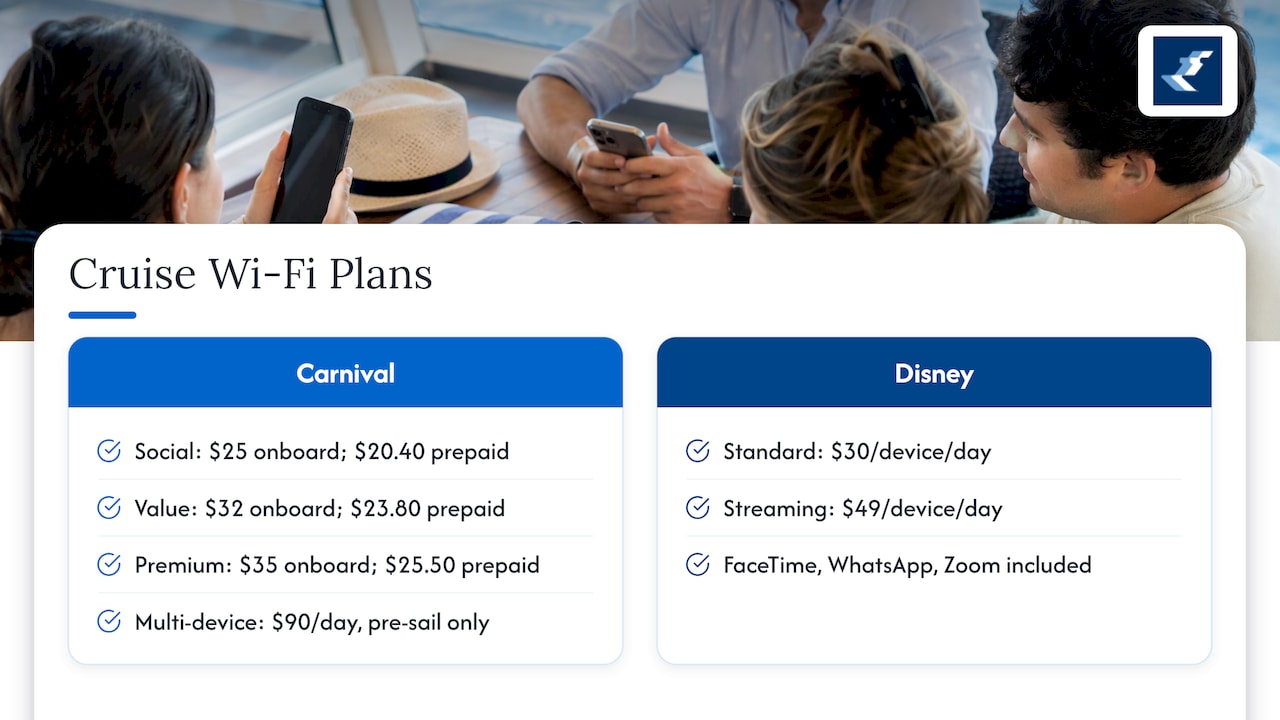
Prices change often, so read these as published figures for the dates given. After Carnival’s December 2025 price change, its Social plan was $25 a day onboard ($20.40 pre-purchased), Value $32 a day ($23.80 pre-purchased) and Premium $35 a day ($25.50 pre-purchased). A Premium Multi-Device plan was $90 a day, available only before sailing. iMessage was included in all plans and FaceTime on the Value and Premium plans (Luxury Cruising, December 2025).
On Disney, the standard Internet Package was $30 per device per day in January 2026, up from $26, and includes FaceTime, WhatsApp and Zoom calls. The Internet + Streaming Package was $49 per device per day for faster speeds (DCL Fan, January 2026).
Groups can cut the cost. Carnival plans can be shared across devices, one account at a time, so friends can pass a single plan between phones. Many ports also have their own Wi-Fi, so a day pass can replace a week-long plan (Cruzely, October 2025). In that same worked example of 12 travelers, three multi-device plans at $90 a day covered 12 phones for $1,890 for the week, against $1,999.20 for twelve Value plans. The catch is that it must be bought online before the cruise, so the group has to decide who is on which plan in advance (CruiserHacks, November 2026).
Two practical habits. Put your phone in airplane mode before boarding to avoid international roaming charges, and research Wi-Fi availability and cost before you go (AARP). And agree on one rule for the group: meet at a set time each day, so nobody needs a data plan just to find each other.
A planning timeline for the group planner
If you are the one organizing, a rough sequence keeps the pressure off:
- Week 1: Post the four questions (days, budget, purpose, departure port) and collect answers.
- Week 2: Shortlist three sailings that fit the shortest vacation window and the lowest budget.
- Week 3: Pick the cabin type, compare the same sailing across sources, and set a booking day.
- Booking day: Reserve all cabins in one sitting, link the reservations and share confirmations.
- Before sailing: Agree on Wi-Fi, dining plans and shore excursions, and pin the plan in the chat.
Booking early gives the group more cabin choice together, which matters when you want adjacent rooms. Our early booking guide for first-timers explains the advantages.
Find the sailing and watch the price with ChooseCruise
Comparing sailings for a group usually means a lot of tabs. ChooseCruise brings offers from travel agency partners into one searchable catalog, so you can compare cabin-by-cabin fares across cruise lines side by side. It tracks fare changes and sends alerts when a sailing you watch changes price. Booking is available in the app, and AI-assisted recommendations can narrow the list when your group has mixed tastes.
Start with the cruise search engine, set your length and port, and share the shortlist with the group. If you already have a sailing in mind, turn on price drop alerts so the planner knows when to book. You can also browse current cruise deals or see all cruise lines compared.
For a winter trip, our December cruise deals page is a good place to begin.
Our perspective
The hardest part of a cruise with friends is not choosing the ship. It is getting five or six people to agree on a date, a budget and a cabin type before prices move.
That is why we think a group trip should start from a shared shortlist, not from separate searches. When everyone looks at the same sailings, with the same cabin-by-cabin fares side by side, the conversation changes from “which site did you find that on?” to “which of these three do we like?”
Price tracking matters for the same reason. A group decision takes days, and fares can change in that time. Alerts on the sailings you are watching mean the planner books when the group is ready and the price is one everybody has seen.
Our advice to first-time groups: keep it short, keep it simple, and let the ship have enough variety for different personalities. You can always sail longer next time.
Igor
FAQ
What is the best cruise for a group of friends?
For most mixed groups, a 5 to 7 night sailing on a ship with plenty of variety in dining, entertainment and activities is the safest choice. If time or budget is tight, 3 to 4 nights works well for celebrations. Match the itinerary to what you do together: beaches for relaxed groups, Alaska for active ones.
Is it cheaper to share a cabin with friends?
Often, yes. Cruise pricing is usually built around two people per cabin, and on some lines additional guests in the same cabin pay a reduced rate, as one Carnival cost guide describes (EatSleepCruise). Check the cabin’s maximum occupancy and the actual fare for the sailing you choose.
How do we make sure our cabins are next to each other?
Choose cabins on the same deck and hallway from the deck plan, book them all in one sitting, and ask for the reservations to be linked so the ship knows you travel together (CruiserHacks). If you want true connecting rooms, select that specifically when booking.
Can you FaceTime friends on a cruise?
Yes, if you buy a Wi-Fi plan that supports it. On Carnival, FaceTime was available on the Value and Premium plans as of December 2025, and Disney’s standard internet package includes FaceTime as of January 2026. Quality can dip when speeds drop, and port Wi-Fi is often a cheaper option on shore days.
Sources
- Royal Caribbean: How to plan cruises for friends
- Royal Caribbean: Planning a group cruise
- EatSleepCruise: Best first-time cruises by traveler type
- EatSleepCruise: How much does a Carnival cruise cost
- AARP: Smart guide to cruises
- CruiserHacks: Cruising as a group of 12
- Luxury Cruising: Carnival Wi-Fi prices
- Cruzely: Carnival Wi-Fi reviewed
- DCL Fan: Disney internet package prices
Recommended
Related reading
6 Best Cruise Destinations 2026 for Smart First-Time Travelers
Discover the 6 best cruise destinations 2026 with expert tips for tech-savvy first-time travelers, including personalized advice for easier cruise booking.
Cruise Package Explained: Stress-Free Vacation Booking
Cruise package means bundled travel with accommodations, meals, entertainment, excursions. Learn the types, inclusions, pros, costs, and mistakes to avoid.
7 Smart Ways to Save on Cruises for Modern Travelers
Discover 7 smart ways to save on cruises with easy, practical tips designed for today’s digital cruise travelers. Learn to maximize value and minimize costs.