What Is a Cruise Deposit? A First-Timer’s Guide

TL;DR:
- A cruise deposit is a partial upfront payment that secures your cabin and reduces your total fare. It typically ranges from $100 to $800 per person and is non-refundable if you choose a non-refundable fare. The remaining balance is due before the final payment deadline, which is usually 60 to 120 days before departure.
A cruise deposit is a partial upfront payment that reserves your cabin and holds your booking on a specific sailing. It counts toward your total cruise fare, not as a separate fee. You pay the remaining balance later, by a deadline the cruise line sets. Understanding how cruise deposits work before you book saves you from surprise costs, missed deadlines, and lost money. This guide covers deposit amounts, refund policies, payment schedules, and practical planning tips for first-time cruisers.
What is a cruise deposit and how does it work?
A cruise booking deposit is a partial payment made at booking to secure your cabin reservation on a specific sailing date. It is applied directly toward your total cruise fare. Think of it as a placeholder that tells the cruise line: this cabin is mine.

The deposit does not pay for your full trip. You still owe the remaining balance, called the final payment, which is due by a deadline set by the cruise line. Until that final payment clears, your booking is technically provisional. The deposit is the first financial step, but the final payment is the real commitment.
One thing first-time cruisers often miss: the deposit does not cover onboard extras. Alcoholic drinks, specialty dining, shore excursions, gratuities, and Wi-Fi are billed separately from your cabin fare. Budget for those costs on top of your deposit and final balance.
How much is a cruise deposit?
Deposit amounts typically range from $100 to $500 per person, depending on the cruise line, trip length, cabin category, and any active promotions. That range is wide because cruise lines use different pricing structures. A short weekend sailing costs far less to hold than a 14-night transatlantic voyage.
Royal Caribbean publishes some of the clearest deposit tiers in the industry:
- 1–5 night cruises: $100 per person
- 6–9 night cruises: $250 per person
- 10–14 night cruises: $450 per person
- 15+ night cruises: $800 per person
- Suite bookings: 10% of total fare or the standard deposit, whichever is higher
Norwegian Cruise Line and Carnival Cruise Line use similar tiered structures, though exact amounts vary by sailing and cabin type. Suite deposits are higher across the board because suites carry limited inventory and a much higher total fare. A 10% deposit on a $6,000 suite is $600, well above the standard flat rate.
Pro Tip: Check for reduced deposit promotions before booking. Cruise lines regularly run deals where you can hold a cabin for as little as $50 per person. These promotions are common in january and february when demand dips after the holiday season.
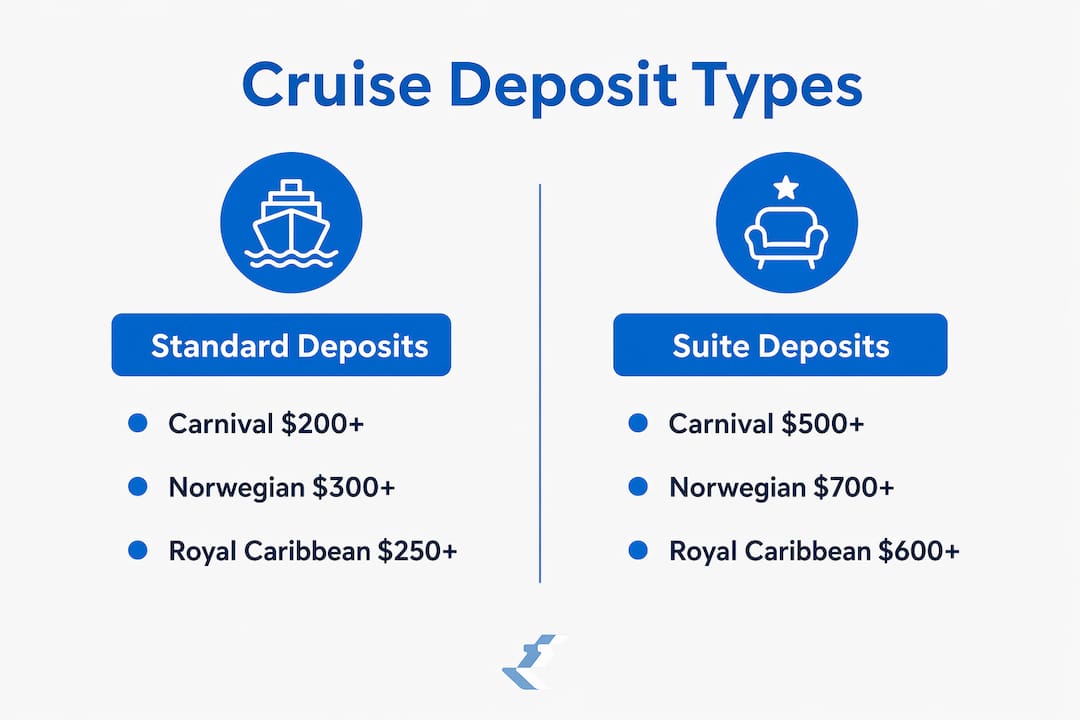
Promotions also affect deposit requirements for cruises. A discounted fare may come with a lower deposit but stricter cancellation terms. Always read what the promotion includes before you commit.
When and how do you pay the deposit and final balance?
The payment process follows a clear sequence. Here is how it works from booking to sailing:
- Pay the deposit at booking. This locks in your cabin and confirms your reservation. You can usually pay by credit card, debit card, or through a travel agent.
- Receive your booking confirmation. The cruise line sends a confirmation with your sailing details and the final payment due date.
- Track your final payment deadline. Final payment is due 60–120 days before departure, depending on the cruise line and trip length. Royal Caribbean requires final payment 75–120 days out. Norwegian Cruise Line requires full payment 120 days before sailing for bookings made after august 2022.
- Pay the remaining balance by the deadline. The final payment covers the difference between your deposit and the total fare.
- Receive your travel documents. After full payment clears, the cruise line releases your boarding passes and itinerary details.
Missing the final payment deadline has real consequences. The cruise line can cancel your reservation and you may lose your deposit along with any promotional pricing you locked in. Set a calendar reminder at least two weeks before the due date so you have time to arrange funds.
One important exception: if you book a cruise after the final payment deadline has already passed, the cruise line typically requires full payment at the time of booking. There is no deposit option at that point. ChooseCruise covers this scenario in detail in its guide to last-minute cruise booking.
Are cruise deposits refundable?
Refundability depends entirely on the fare type you choose at booking. This is one of the most misunderstood aspects of cruise deposit payment, and it catches first-time cruisers off guard.
| Fare Type | Deposit Refundable? | Cancellation Terms |
|---|---|---|
| Refundable fare | Yes, before final payment deadline | Full deposit returned if canceled in time |
| Non-refundable fare | No | Deposit forfeited on cancellation, even before final payment |
| Discounted/promotional fare | Usually no | May allow changes with a penalty fee |
Refundable deposits give you a safety net. If your plans change before the final payment deadline, you cancel and get your deposit back. Non-refundable deposits are typically attached to discounted fares. You pay less upfront or get a lower base fare, but you forfeit the deposit if you cancel for any reason.
Pro Tip: If your travel dates are flexible or your plans might change, pay for a refundable fare even if it costs slightly more. The deposit protection is worth the price difference.
Some cruise lines allow you to change the sailing date on a non-refundable fare without losing the full deposit, but they charge a change fee. Read the fare conditions carefully before you click “book.” The difference between a refundable and non-refundable deposit can mean hundreds of dollars if your plans shift.
How do deposit requirements vary by cruise line and cabin type?
Deposit requirements for cruises are not uniform across the industry. Cruise lines set their own rules, and cabin type plays a major role in how much you pay upfront.
| Cruise Line | Standard Deposit (7 nights) | Suite Deposit | Final Payment Due |
|---|---|---|---|
| Royal Caribbean | $250 per person | 10% of total fare | 75–90 days before sailing |
| Norwegian Cruise Line | Varies by sailing | Higher percentage | 120 days before sailing |
| Carnival Cruise Line | Varies by sailing | Higher than standard | 75–90 days before sailing |
Suite deposits stand apart from standard cabin deposits for two reasons. First, suites carry a much higher total fare, so a percentage-based deposit produces a larger dollar amount. Second, suite inventory is limited. Cruise lines use higher deposits to filter out non-serious buyers and protect revenue on their most valuable cabins.
Cruise duration also drives deposit size. A 3-day Carnival sailing requires a smaller deposit than a 12-night Royal Caribbean voyage. If you are considering a shorter trip to test the waters, ChooseCruise lists current 3-day cruise deals with deposit details included.
Deposit requirements vary even within the same cruise line based on passenger count, cabin category, and active pricing tiers. Two travelers booking the same sailing on different days may pay different deposit amounts if a promotion launched between their bookings.
Practical tips for planning your cruise deposit and payments
Smart financial planning around your deposit protects your money and your vacation. These tips apply whether you are booking your first cruise or your fifth.
- Book early and use the deposit to lock in pricing. Cruise fares often rise as the sailing date approaches. A deposit lets you secure today’s price while spreading the remaining cost over weeks or months. ChooseCruise’s guide on how cruise deals are priced explains how early booking affects your total cost.
- Choose a refundable fare if your schedule is uncertain. The flexibility is worth the slightly higher base price if there is any chance your plans could change.
- Set a payment reminder well before the final due date. Missing the deadline by even one day can result in cancellation and deposit forfeiture.
- Budget beyond the deposit. Port fees, taxes, gratuities, and onboard spending are not included in the base fare. A thorough cruise budget plan accounts for all of these costs upfront.
- Watch for reduced deposit promotions. Cruise lines run these regularly, especially in off-peak booking windows. A lower deposit frees up cash for onboard expenses.
- Understand what your deposit covers. It applies only to the base cabin fare. Specialty restaurants, drink packages, and excursions are charged separately.
The deposit is a tool, not just a formality. Used well, it lets you hold a cabin you want at a price you like, while giving you time to arrange the full payment.
Key Takeaways
A cruise deposit is the partial upfront payment that secures your cabin, counts toward your total fare, and must be followed by full payment before the cruise line’s final deadline to keep your booking.
| Point | Details |
|---|---|
| Deposit secures your cabin | Pay at booking to hold your reservation; it applies toward the total fare. |
| Amounts range widely | Deposits typically run $100–$800 per person based on cruise length and cabin type. |
| Final payment has a hard deadline | Royal Caribbean and Norwegian require full payment 75–120 days before sailing. |
| Refundability depends on fare type | Refundable fares return your deposit if canceled before the final payment deadline. |
| Deposits don’t cover extras | Gratuities, drinks, excursions, and Wi-Fi are billed separately onboard. |
The deposit is not your biggest commitment
First-time cruisers tend to fixate on the deposit as the scary part of booking. After years of watching people plan cruises, I think that focus is misplaced. The deposit is actually the easy part. It is a relatively small amount that holds your cabin while you figure out the rest.
The real commitment is the final payment deadline. That is the date that determines whether your booking survives. Miss it and you lose the deposit, the cabin, and often the promotional rate you locked in. The deposit just gets the process started.
My honest advice: treat the final payment due date as your true booking deadline, not the deposit date. Write it on your calendar the day you book. Then work backward and figure out how much you need to save each month to hit that number comfortably. That simple habit removes most of the financial stress from cruise planning.
One more thing worth knowing: non-refundable deposits are not inherently bad. If you are confident in your travel dates, a non-refundable fare often comes with a meaningfully lower base price. The risk is real, but so is the saving. Just go in with eyes open.
— Igor
ChooseCruise makes cruise deposit planning straightforward
Planning a cruise means tracking deposit amounts, final payment deadlines, fare types, and cabin options all at once. ChooseCruise brings all of that into one place.

ChooseCruise offers real-time price tracking, clear deposit and payment details at every step, and AI-powered recommendations that match your budget and travel style. Whether you are looking for a short getaway or a longer sailing, you can compare cruise deals and see exactly what you owe at booking and when the final balance is due. No digging through fine print. No surprises at checkout.
FAQ
What is a cruise deposit used for?
A cruise deposit is a partial payment made at booking that reserves your cabin and applies toward your total cruise fare. It is not a separate fee.
How much is a typical cruise deposit per person?
Deposits typically range from $100 to $800 per person depending on the cruise line, trip length, and cabin type. Royal Caribbean charges $100 for 1–5 night sailings and $800 for voyages of 15 nights or more.
Are cruise deposits refundable if you cancel?
Refundability depends on your fare type. Refundable fares return your deposit if you cancel before the final payment deadline. Non-refundable fares forfeit the deposit on cancellation regardless of timing.
When is the final payment due after the deposit?
Final payment is commonly due 60–120 days before departure. Royal Caribbean requires payment 75–120 days out, while Norwegian Cruise Line requires full payment 120 days before sailing.
What happens if you miss the final payment deadline?
The cruise line can cancel your reservation and you may lose your deposit and any promotional pricing. Set a payment reminder at least two weeks before the due date to avoid this.
Recommended
Related reading
6 Best Cruise Destinations 2026 for Smart First-Time Travelers
Discover the 6 best cruise destinations 2026 with expert tips for tech-savvy first-time travelers, including personalized advice for easier cruise booking.
Cruise Package Explained: Stress-Free Vacation Booking
Cruise package means bundled travel with accommodations, meals, entertainment, excursions. Learn the types, inclusions, pros, costs, and mistakes to avoid.
7 Smart Ways to Save on Cruises for Modern Travelers
Discover 7 smart ways to save on cruises with easy, practical tips designed for today’s digital cruise travelers. Learn to maximize value and minimize costs.