What Is a Cruise Segment? A First-Timer’s Guide

TL;DR:
- A cruise segment is a bookable portion of a longer voyage, allowing travelers to experience part of a world cruise without the full commitment.
- Segments offer flexibility, lower costs, and the same onboard experience as full cruises, making them ideal for first-time cruisers.
A cruise segment is a defined portion of a longer cruise itinerary, sold separately so you can experience part of a grand voyage without booking the entire trip. This concept has reshaped how first-time cruisers access world-class travel. Azamara, for example, has partitioned its 2028 world cruise into 14 distinct segments, letting travelers design their own voyage chapter by chapter. The cruise industry also uses the term “segment” in a second way: to classify the market into four tiers based on service level and ship size. Understanding both meanings gives you a real advantage when planning your first cruise.
What is a cruise segment in itinerary planning?
A cruise segment is one leg of a longer voyage, typically a world cruise, broken into shorter sailings that travelers can book independently. World cruises last 3–4 months and carry substantial upfront costs. Segments solve both problems by letting you choose a portion that fits your schedule and budget.

Segment lengths vary widely. A single leg might run two weeks, while others stretch to 60 days or more. The key point is that you board and disembark at different ports than the full-cruise passengers, joining the ship mid-voyage or leaving before it completes the full circle.
The onboard experience does not change based on how long you stay. Dining, service, and enrichment programs on a segment match exactly what full-cruise passengers receive. That means you get the same specialty restaurants, lecture series, and spa facilities, just for a shorter stretch of time.
Here is what makes segments particularly useful for first-time cruisers:
- Flexible duration. You can sail for 14 days instead of committing to 175 nights.
- Regional focus. Pick the part of the world that interests you most, whether that is Southeast Asia, the Mediterranean, or South America.
- Lower total cost. A segment costs a fraction of the full voyage price while delivering the same luxury experience.
- Trial run. Segments let you test extended cruising before committing to a full world cruise.
- Same ship, same crew. You benefit from the continuity of a world-class vessel without the full time commitment.
Pro Tip: If you are drawn to a specific region, search for segments that begin and end in major hub cities. This makes flight planning much simpler and gives you more time to explore before or after the cruise.
How are cruise market segments classified?
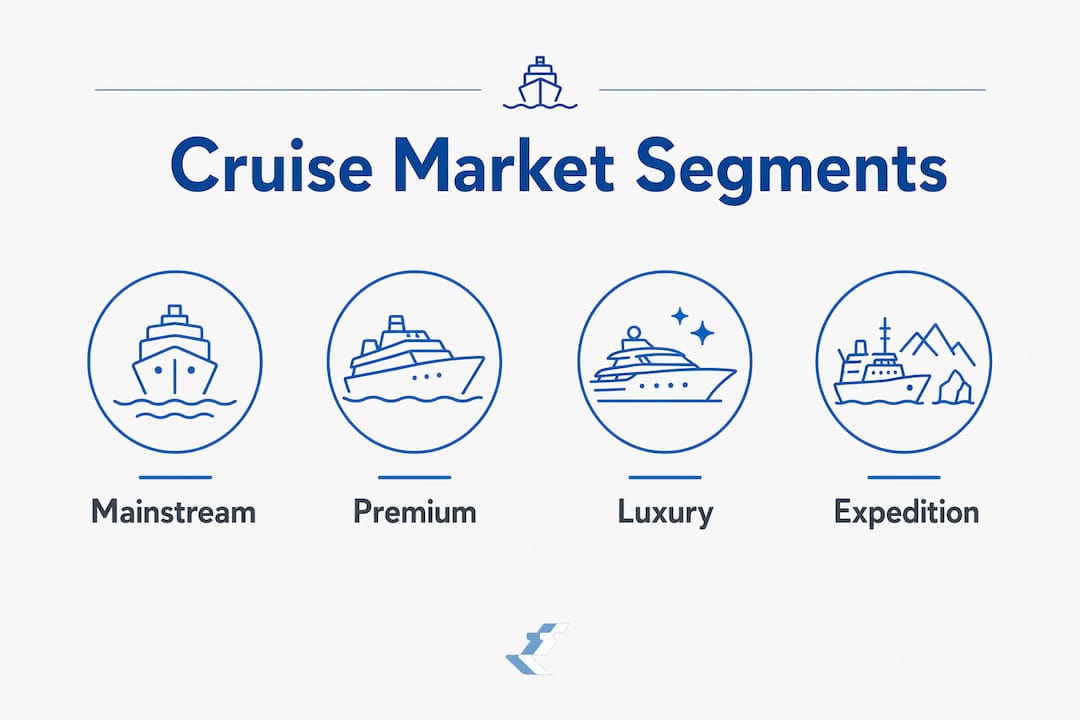
The cruise industry classifies all cruise lines into four market segments: mainstream, premium, luxury, and expedition. Each segment is defined by passenger density, pricing, and itinerary style. Knowing which segment fits your expectations prevents a mismatch between what you pay and what you experience.
Mainstream
Mainstream cruises are the largest ships afloat, carrying thousands of passengers and offering resort-style entertainment. Think water parks, Broadway-style shows, and dozens of dining options. Pricing is accessible, and these ships work well for families or first-timers who want variety and activity.
Premium
Premium lines sit one step above mainstream in service quality and ship size. Ships are slightly smaller, dining is more refined, and the overall atmosphere is calmer. Pricing is moderate to high, and the crowd tends to skew toward experienced travelers who want more polish without full luxury pricing.
Luxury
Luxury cruises use small ships, often carrying fewer than 700 passengers, and include far more in the base fare: drinks, gratuities, shore excursions, and fine dining. Luxury lines emphasize small ships and more inclusions, which creates a more personal, unhurried experience. World cruise segments almost always fall into this category.
Expedition
Expedition cruises prioritize remote destinations over onboard amenities. Ships are purpose-built for polar ice, shallow rivers, or volcanic archipelagos. Passenger counts are small, and the experience centers on wildlife, science, and guided exploration. This segment suits adventurous travelers more than first-timers seeking relaxation.
Knowing these four tiers helps you filter options quickly. A first-timer who wants a relaxed, all-inclusive feel belongs in the luxury segment. Someone traveling with kids and a tighter budget fits mainstream. You can use ChooseCruise’s cruise planning guide to match your preferences to the right tier before you start comparing prices.
What are the pros and cons of booking a segment vs. a full world cruise?
Segments offer real advantages, but they also come with trade-offs worth knowing before you book. Here is a clear breakdown:
- Shorter time commitment. Most working travelers cannot take 3–4 months off. A 30-day segment fits a standard vacation window without requiring a career break.
- Lower cost of entry. Segments let travelers experience world voyages in smaller, more affordable portions. You access the same luxury ship at a fraction of the full-cruise price.
- Retained onboard quality. The service level does not drop for segment passengers. You receive the same dining, entertainment, and amenities as someone who boarded on day one.
- Complex flight logistics. Segment travel requires open-jaw tickets, meaning you fly into one city and out of another. These multi-city itineraries cost more and take longer to plan than standard round-trips.
- More sea days on some legs. Certain segments cross long ocean stretches with few port stops. A high ratio of sea days to port days can frustrate travelers who want constant shore exploration.
- Limited cabin availability. Popular segments on small luxury ships sell out fast. Late bookers often face reduced cabin choices or higher prices.
The right choice depends on your lifestyle. If you have four months free and the budget to match, a full world cruise delivers unmatched continuity and cultural depth. If your schedule is tighter, a well-chosen segment gives you the same quality experience in a manageable window.
Pro Tip: Before booking, count the port days versus sea days on any segment you consider. A segment with 60% port days gives you far more shore time than one built around ocean crossings.
How can first-time cruisers choose and book the right segment?
Choosing the right cruise segment comes down to four decisions: destination, duration, timing, and logistics. Getting all four right before you book saves money and prevents frustration.
Start with destination. Pick the region of the world you most want to see, then find segments that cover those ports. Southeast Asia, the Mediterranean, and the Caribbean each have distinct seasons, so match your travel window to the best weather for that region.
Book early. Cruise professionals recommend booking 18 months in advance to secure preferred cabins and the best pricing. This is especially true for small luxury ships where cabin inventory is limited. Waiting until six months out often means settling for whatever is left.
Plan your flights at the same time as your cruise. Multi-city airfare bookings for open-jaw itineraries require early coordination. Booking flights and the cruise simultaneously prevents the scenario where your ideal cabin is available but no reasonable flight connects to the embarkation port.
Use these practical steps when evaluating segment options:
- Check the port-to-sea-day ratio. Aim for segments where at least half the days are port days if shore exploration matters to you.
- Review tender port frequency. Tender ports require a small boat transfer to shore, which adds time and can be canceled in rough weather.
- Align the segment with your interests. History buffs do better on Mediterranean segments. Nature lovers get more from expedition or South Pacific legs.
- Budget for excursions separately. Even on all-inclusive luxury lines, some shore excursions carry extra fees. Research costs before you commit to a segment.
- Read the cabin deck plan. On small ships, cabin location affects noise and motion. Mid-ship, lower-deck cabins offer the smoothest ride.
Pro Tip: Use ChooseCruise’s personalization tools for first-timers to filter segments by destination, duration, and budget in one place. It cuts the research time significantly.
For budget-conscious first-timers, pairing early booking with the right cruise booking steps can unlock meaningful savings on segment fares.
Key Takeaways
A cruise segment is the most practical way for first-time cruisers to access world-class voyages without the full time or financial commitment of a complete world cruise.
| Point | Details |
|---|---|
| Segments divide long voyages | A segment is one bookable leg of a longer cruise, typically 14–60 days. |
| Same onboard experience | Segment passengers receive identical dining, service, and amenities as full-cruise guests. |
| Four market tiers exist | Mainstream, premium, luxury, and expedition segments define service level and ship size. |
| Book 18 months ahead | Early booking secures better cabins and lower prices, especially on small luxury ships. |
| Flight logistics need planning | Open-jaw tickets for segment travel cost more and require early coordination with your cruise booking. |
Why segments changed how I think about world cruising
My honest view is that cruise segments are one of the most underused tools in travel planning. Most first-timers assume world cruising is for retirees with unlimited time and money. That assumption is wrong, and segments are the proof.
The moment I understood that a 14-day segment on a luxury ship delivers the exact same experience as day 90 of a full world cruise, the math changed completely. You are not getting a lesser product. You are getting the same ship, the same crew, and the same ports, just for a shorter window.
What I find most compelling is the stepping-stone effect. Travelers who book one segment almost always come back for a longer one. The experience is calibrated to make you want more. That is not accidental. Cruise lines design segments as entry points, knowing that a first-timer who completes a 30-day leg is far more likely to book a 90-day voyage two years later.
My advice to anyone planning their first cruise is this: stop treating the full world cruise as the goal and start treating a well-chosen segment as the goal. Pick a region you have always wanted to see, book 18 months out, sort your flights early, and go. The full voyage will still be there when you are ready for it.
— Igor
Plan your first cruise segment with ChooseCruise
Finding the right segment used to mean hours of cross-referencing itineraries, pricing, and availability across multiple sites. ChooseCruise brings all of that into one place.
The platform covers cruise segments across all four market tiers, from short mainstream legs to luxury world cruise portions. Real-time price tracking shows you when fares drop, and the AI-powered recommendation engine filters options by destination, duration, and budget. Whether you want a 14-day Mediterranean leg or a 45-day Pacific crossing, you can search and compare cruise deals without the usual back-and-forth. First-time cruisers can also browse short cruise options to get a feel for onboard life before committing to a longer segment.
FAQ
What is a cruise segment in simple terms?
A cruise segment is a shorter, bookable portion of a longer cruise itinerary, such as a world cruise, that lets you sail part of the route without committing to the full voyage.
Are cruise segments cheaper than full world cruises?
Yes. Segments cost a fraction of the full-cruise price while delivering the same onboard service, dining, and amenities as the complete voyage.
How long do cruise segments typically last?
Segments typically last 30–60 days, though some are as short as two weeks depending on the cruise line and itinerary.
When should I book a cruise segment?
Book approximately 18 months in advance to secure your preferred cabin and the best available pricing, especially on small luxury ships with limited inventory.
Do I need special flights for a cruise segment?
Yes. Segments require open-jaw or multi-city tickets because you board and disembark at different ports. Plan airfare early alongside your cruise booking to avoid limited or expensive flight options.
Recommended
Related reading
6 Best Cruise Destinations 2026 for Smart First-Time Travelers
Discover the 6 best cruise destinations 2026 with expert tips for tech-savvy first-time travelers, including personalized advice for easier cruise booking.
Cruise Package Explained: Stress-Free Vacation Booking
Cruise package means bundled travel with accommodations, meals, entertainment, excursions. Learn the types, inclusions, pros, costs, and mistakes to avoid.
7 Smart Ways to Save on Cruises for Modern Travelers
Discover 7 smart ways to save on cruises with easy, practical tips designed for today’s digital cruise travelers. Learn to maximize value and minimize costs.