Cruise Insurance Explained: What Every Traveler Should Know

Cruise insurance is a specialized form of travel insurance built around the specific risks of a cruise vacation. Unlike a standard travel policy, it covers scenarios unique to life at sea: missing your ship’s departure, getting evacuated from international waters, or being confined to your cabin with a medical issue while the ship is nowhere near a hospital. Providers like Travel Guard® and Seven Corners Travel Insurance offer dedicated cruise plans that bundle trip cancellation, emergency medical, evacuation, and cruise-specific protections into a single policy. Your regular health insurance almost certainly won’t help you here. Medicare and most U.S. commercial health plans do not cover medical care on a cruise ship or maritime evacuations, which is the core reason cruise insurance exists.
Key protections cruise insurance typically includes:
- Trip cancellation and interruption reimbursement for nonrefundable costs
- Emergency medical care onboard, where billing is always private
- Medical evacuation from the ship to a land-based hospital
- Missed embarkation coverage when flight delays cause you to miss departure
- Baggage loss, delay, and theft protection
- Optional add-ons like cabin confinement benefits and missed excursion reimbursement
What does cruise insurance cover in detail?
Coverage falls into a handful of distinct categories, and understanding each one helps you spot gaps before you buy.
Trip cancellation and interruption reimburse your prepaid, nonrefundable expenses if you cancel or cut your trip short for a covered reason, typically illness, a family emergency, severe weather, or certain job-related situations. For a cruise that costs several thousand dollars and was booked months in advance, this is usually the first coverage travelers think about.
Emergency medical care is where cruise insurance earns its keep most dramatically. Ship infirmaries bill privately, and onboard medical care runs $1,500–$3,000 per day. Serious cases that require evacuation to a land hospital can cost $15,000–$50,000 out of pocket. That range reflects helicopter transport, specialized medical flights, and coordination fees, none of which your domestic insurer will touch.
Missed embarkation coverage pays transportation costs when a flight delay or missed connection causes you to miss the ship. Missed connection coverage reimburses a set dollar amount so you can rebook travel and catch the ship at its next port. Missed port-of-call coverage is a related benefit that pays a benefit if the ship itself skips a scheduled stop due to weather or mechanical issues.

Baggage protection covers loss, theft, and delay. If your luggage is delayed at the start of the trip, the policy typically reimburses you for essential items you need to buy before it arrives.
| Coverage Type | What It Pays For | Why It Matters for Cruises |
|---|---|---|
| Trip cancellation | Nonrefundable cruise fare, flights, hotels | Cruises are booked months ahead with large deposits |
| Emergency medical | Onboard treatment, specialist care | Ship infirmaries bill privately and can be very costly per day. |
| Medical evacuation | Ship-to-shore transport, medical flights | Costs can reach tens of thousands of dollars without coverage. |
| Missed embarkation | Rebooking transport to catch the ship | Flight delays are the most common cause |
| Baggage loss/delay | Replacement items, lost luggage reimbursement | Ports of call make baggage recovery difficult |
| Cabin confinement | Daily benefit if confined to cabin by illness | Unique to cruise policies; not in standard travel plans |
Pre-existing condition coverage deserves a separate note. Most policies will cover pre-existing conditions only if you purchase within a specific window after your first trip payment, typically 7–21 days depending on the insurer. Miss that window and a flare-up of a known condition may not be covered.
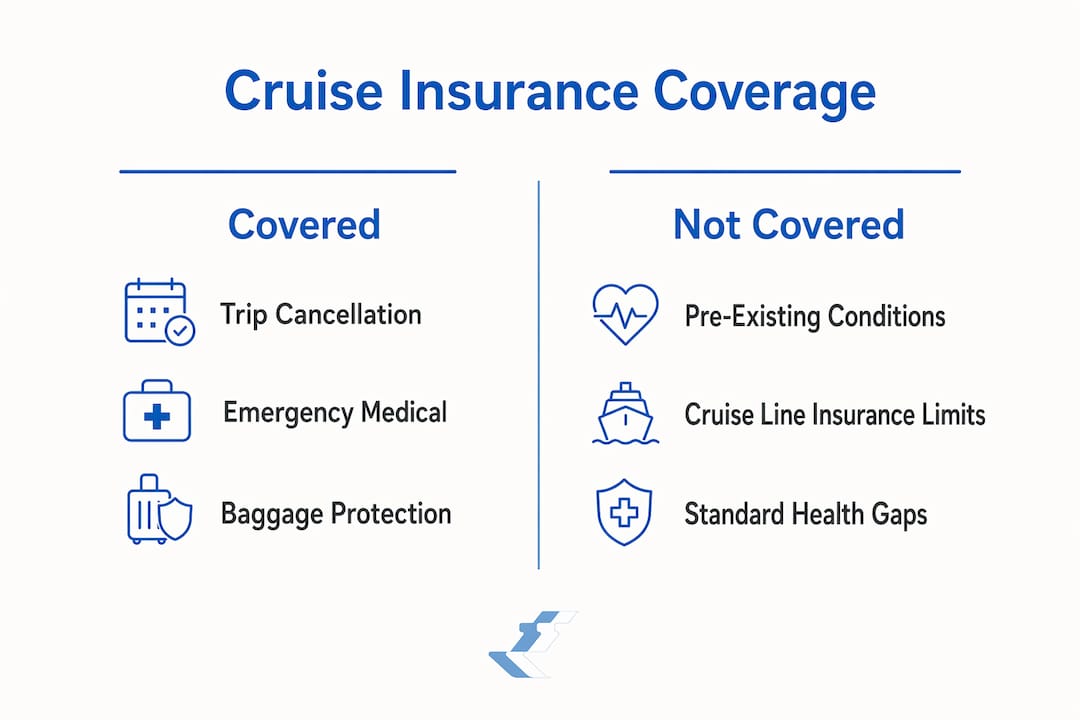
What cruise insurance usually does not cover
Exclusions catch travelers off guard more often than any other part of a policy. The most common one: standard travel insurers will not reimburse a cancellation made because you are worried about a disease outbreak, even if the CDC issues a travel advisory, as it did during COVID-19. Fear of illness is not a covered reason.
Other common exclusions include:
- Cancellations for reasons not listed in the policy (unless you purchased “cancel for any reason” coverage)
- Pre-existing conditions when the policy was purchased outside the eligibility window
- Itinerary changes made voluntarily by the cruise line that don’t result in a covered loss
- Losses covered by another source, such as airline compensation for a delayed bag
- Incidents involving alcohol or drug use
Cruise line insurance sold at booking tends to have narrower exclusion lists on paper, but the coverage itself is often thinner. Cruise line plans may reimburse cancellations as future cruise credits rather than cash, which protects the cruise line’s revenue more than your wallet. Reading the fine print on any policy, especially the definitions of “covered reason,” is the single most useful thing you can do before purchasing.
When buying cruise insurance makes sense and how to do it
The decision comes down to three factors: how much you have prepaid and can’t get back, how far from medical care you’ll be, and your personal health situation.

For a short domestic cruise with a modest fare, the financial risk may be low enough to skip coverage. For a 10-day international itinerary with flights, hotels, and excursions all booked in advance, the math shifts quickly. Cruise vacations involve coordinated nonrefundable bookings across multiple travel components, and a single disruption can unravel all of them.
Cost: Comprehensive cruise insurance typically runs 4%–10% of your total prepaid, nonrefundable trip expenses. A $10,000 cruise vacation costs roughly $400–$1,000 to insure, depending on your age and the coverage limits you choose.
Timing: Buy as soon as you make your first trip payment. Early purchase unlocks optional upgrades and pre-existing condition waivers that disappear if you wait. Technically, you can buy up to the day before departure, but several key benefits won’t apply at that point.
Where to buy: You have three main options.
- Cruise line plans are convenient and easy to add at booking, but coverage tends to be narrower and reimbursements often come as cruise credits.
- Independent third-party insurers like Travel Guard® and Seven Corners Travel Insurance offer broader cancellation reasons, cash reimbursements, and higher medical limits. Third-party plans also cover flights, hotels, and excursions, not just the cruise itself.
- Travel insurance comparison platforms let you view multiple policies side by side. For a deeper look at how to evaluate your options, this cruise travel insurance guide walks through the key factors.
For help choosing a policy that fits your trip, choosing travel insurance resources from independent experts can clarify what to prioritize.
Pro Tip: Focus your coverage budget on the catastrophic risks first: medical evacuation and emergency medical care. A $50,000 evacuation bill is the scenario that genuinely wrecks a family’s finances. Baggage delay is annoying; an uninsured medevac flight is a different category of problem entirely.
What travel insurance experts say about cruise coverage
Travel insurance professionals consistently make the same point: the complexity of a cruise vacation is what makes coverage worth considering. You’re not just booking a hotel room you can cancel. You’re coordinating flights, transfers, port excursions, and a ship that will leave without you if you’re late.
Standard U.S. health insurance does not cover medical evacuation or treatment at sea. That gap is not a technicality. It means a traveler who has a cardiac event in the middle of the Caribbean faces a five-figure bill with no domestic insurer to call. Experts specifically recommend looking for policies with high evacuation limits, not just token coverage.
The advice on prioritizing high-cost risks over minor inconveniences is consistent across the industry. A policy that covers cabin confinement but has a low evacuation cap is the wrong tradeoff. Read the declarations page for the evacuation limit before anything else.
Medical evacuation from a cruise ship can cost $15,000–$50,000, and neither Medicare nor most commercial U.S. health plans cover it.
Independent policies generally provide cash reimbursements and broader cancellation benefits, while cruise line insurance tends to favor the company’s own revenue protection. That contrast is not subtle once you read both policy documents side by side. Experts also flag that third-party plans cover the full trip ecosystem, including flights and hotels booked separately, which cruise line plans typically ignore.
Key Takeaways
Cruise insurance fills a genuine gap that standard health and travel policies leave open, and the evacuation cost alone justifies serious consideration for any international voyage.
| Point | Details |
|---|---|
| Medical coverage gap | Medicare and most U.S. health plans don’t cover onboard care or maritime evacuations. |
| Evacuation cost exposure | Emergency evacuation runs $15,000–$50,000 without dedicated cruise insurance. |
| Buy early for full benefits | Purchase within 7–21 days of your first payment to access pre-existing condition waivers. |
| Third-party plans pay more | Independent insurers reimburse cash and cover flights and hotels; cruise line plans often pay future credits. |
| Cost benchmark | Comprehensive coverage typically costs 4%–10% of total nonrefundable trip expenses. |
Ready to book the cruise worth protecting? ChooseCruise uses real-time price tracking and personalized recommendations to match you with the right voyage at the best available rate. Whether you’re planning a quick getaway or a two-week international itinerary, find and compare cruise deals in one place, then add the right coverage before you sail.
Recommended
Related reading
6 Best Cruise Destinations 2026 for Smart First-Time Travelers
Discover the 6 best cruise destinations 2026 with expert tips for tech-savvy first-time travelers, including personalized advice for easier cruise booking.
Cruise Package Explained: Stress-Free Vacation Booking
Cruise package means bundled travel with accommodations, meals, entertainment, excursions. Learn the types, inclusions, pros, costs, and mistakes to avoid.
7 Smart Ways to Save on Cruises for Modern Travelers
Discover 7 smart ways to save on cruises with easy, practical tips designed for today’s digital cruise travelers. Learn to maximize value and minimize costs.