Cruise Single Supplement: What It Costs and How to Avoid It

A cruise single supplement is the surcharge a cruise line adds when one person occupies a cabin priced for two. On many mainstream lines it is 100% of the per-person fare, so you pay double. You can shrink or skip it by booking a dedicated solo cabin, catching a reduced-supplement promotion on a specific sailing, or comparing the full one-guest total across cabin types before you commit. We built ChooseCruise to make that comparison fast: one searchable catalog, cabin-by-cabin fares and alerts when a sailing you watch changes price.
TL;DR
- Cabins are priced per person on the assumption of two guests, so a solo traveler is usually charged a supplement on top of the single fare. The usual figure is up to 100%, and some lines go to 200%.
- Dedicated solo cabins and limited-time reduced-supplement offers are the two real ways to cut the cost. Both have limited supply.
- A “solo” label is not a guaranteed saving. Compare the complete total for one guest, including taxes and fees, on the same departure.
- Taxes and port fees are generally paid once, so the effective premium is often lower than the headline percentage.
- Price tracking helps because supplement waivers tend to appear on sailings that are not filling.
Table of Contents
- What a single supplement is and why it exists
- How much it adds, line by line
- Ways to avoid or reduce the supplement
- Compare the full one-guest total, not the label
- Which lines to look at first
- Find your solo fare on ChooseCruise
- FAQ
- Sources
What a single supplement is and why it exists
Nearly every cruise cabin is designed for at least two people, and the advertised fare is a per-person price based on double occupancy. When you book alone, the line charges a single supplement, an added fee for taking a cabin meant for two or more. According to The Points Guy, it compensates for the onboard revenue a second passenger would have generated, such as shore excursions, drinks, spa treatments and casino play. Generally it is 100% of the per-person fare, while taxes and fees are paid only once.
USA TODAY adds two useful points. Lines price a cabin by the revenue they need from the room. Solo guests do not eat, drink or gamble double, so onboard spending softens the real cost of the supplement. Lines also avoid pricing solo cabins above double-occupancy ones, because a traveler could otherwise just book a bigger double room.
A worked example
Say a cabin is advertised at $1,000 per person. A couple pays $2,000 for the cabin. With a 100% supplement, you pay $2,000 as well, so you get the same room for the same price as two people. USA TODAY puts the typical extra charge at 50% to 100% of the fare, which would be $500 to $1,000 on that $1,000 fare.
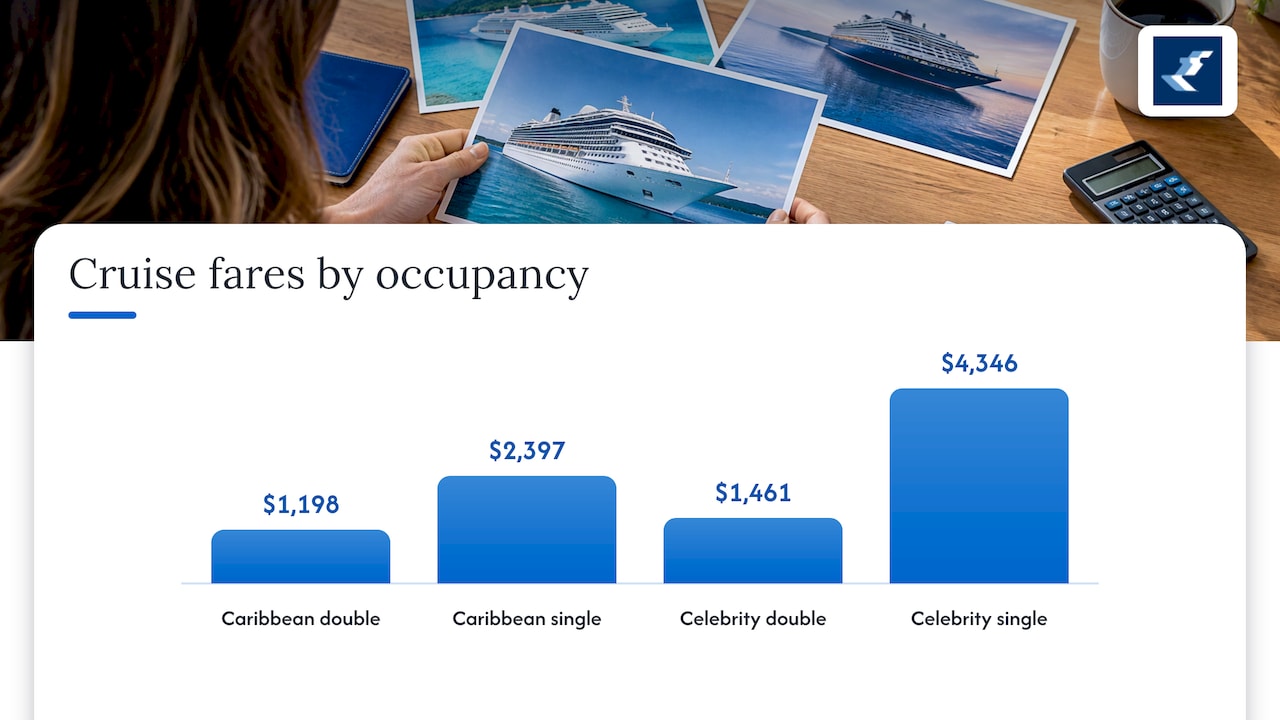
A real fare shows the same pattern. Forbes compared an 8-day Caribbean sailing on Caribbean Princess at $1,198 for double occupancy against $2,397 for a single, the classic doubling. On a Celebrity Reflection balcony cabin it found $1,461 double against $4,346 single, nearly three times the normal rate. That is why you always compare the final one-guest quote rather than assuming the standard rule.
How much it adds, line by line
Supplements run from an extra 5% of the rate up to 200% of the fare, depending on the line, ship and cabin. Cruise Critic’s overview of typical charges on double-occupancy cabins looks like this:
| Cruise line | Typical supplement | Dedicated solo cabins |
|---|---|---|
| Royal Caribbean | 100% to 200% | On select ships |
| Celebrity | 100% to 200% | On select ships |
| Holland America | 100% to 200% | Not noted |
| Princess | 100% to 200% | Not noted |
| Norwegian | 50% to 100% | Yes |
| Carnival | 200% | No |
| Disney | 200% | No |
The solo-cabin column comes from U.S. News, which notes solo staterooms on select Royal Caribbean and Celebrity ships, plus Norwegian solo cabins in studio, inside, ocean view and balcony categories. The same piece says solo accommodations typically range from about 100 to 200-plus square feet. Cruise Critic says Carnival and Disney have no solo cabins.
Fares and policies change by sailing and season, so treat the table as a map of where to look first. The number that matters is the quote for one guest on the exact departure you want.
Luxury and expedition-style lines often sit at the high end of the range. Seabourn’s terms, for example, describe a standard supplement of 200%, and a promotional offer on select sailings reduces it to 125%. Azamara’s published solo rates list reduced supplements of 125% on select sailings and 150% to 175% on transatlantic and longer voyages.
Ways to avoid or reduce the supplement
There are two structural fixes and a handful of tactics. They are worth knowing in this order.
1. Book a dedicated solo cabin
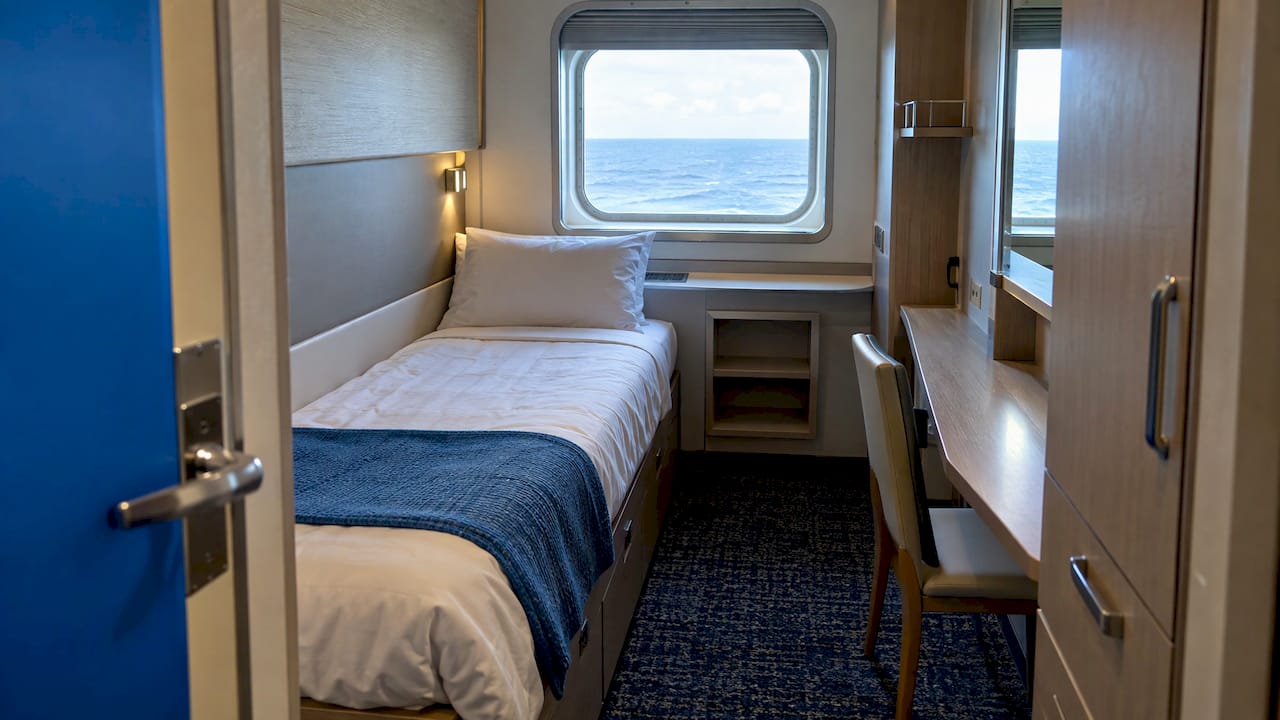
Solo cabins are priced for one person, so there is no supplement to waive. They are the one option that exists every day of the year rather than only during a promotion. The catch is supply. Ships that have them usually offer a small number, so popular sailings can sell out of solo categories early. Book as soon as you know your dates.
Solo cabins are typically smaller than standard rooms, and that is part of how the pricing works. If you are new to cruising and unsure what the categories mean, our guides to cruise cabin types for beginners and stateroom categories for first timers explain inside, ocean view, balcony and suite in plain terms.
2. Catch a reduced-supplement promotion
Some lines run limited offers that cut the supplement on specific sailings and cabin categories. Recent examples from the lines’ own pages show how varied they are:
- Virgin Voyages has offered up to 70% off the second fare for one Sailor in eligible Sea Terrace cabins on select voyages.
- Hurtigruten has offered up to 50% off the single supplement on select Norway coastal and signature voyages. One example showed a 12-day roundtrip from $1,437 against $2,874 for double-occupancy pricing.
- Crystal has run a reduced solo supplement of 25% on selected voyages and suite categories, with fares that include destination fees.
- Regent Seven Seas has offered reduced single supplements on select voyages and suite categories for new bookings in a set window.
The fine print follows a pattern. These offers are capacity controlled, usually apply to new bookings only, and often cannot be combined with other promotions. Several can be modified or withdrawn without notice. Check the terms on the offer page for the sailing you want, and the current dates.
3. Do not assume a sale means no supplement
A big promotion does not automatically waive the supplement. Cunard’s wave-season memo offered up to $600 in onboard credit per stateroom, yet stated that singles would pay a supplement of up to 200%. Always read what the deal says about one-guest bookings.
4. Time your booking
The Points Guy suggests shopping deals during Black Friday or wave season, asking about solo promotions, and considering roommate matching through charter companies. Wave season is the early-year stretch when lines push their biggest sales. Waivers tend to land on sailings that are not filling, so a sailing that is still half empty a few months out is a better candidate than one that is nearly sold.
5. Choose a social format
If your goal is company as much as savings, themed or group sailings help. A tabletop role-playing game cruise, for example, is built around a shared hobby, so a solo traveler arrives with a ready-made group.
Compare the full one-guest total, not the label
The headline percentage is a starting point. Three habits keep you from overpaying or from chasing a false saving.
Set the traveler count to one early. Searching with two guests and halving the price misses the real quote. On some ships, changing to one adult can make certain categories unavailable.
Compare cabin types on the same departure. A dedicated solo category is a different product from a standard cabin priced for one guest. Sometimes a standard or guarantee cabin booked solo costs less than the solo category, so look at both side by side.
Add everything up. Taxes, port fees, gratuities and package rules all change the final number. Port charges are usually paid once rather than doubled, which is why the effective premium is often smaller than the headline. Our cruise port tax guide breaks down what these charges are so you can budget for them.
A quick checklist before you book
- Is the quote for one guest, on the exact sailing and cabin you want?
- Is the supplement a percentage of the fare or a reduced promotional rate, and what are its limits?
- Does the offer need new bookings only, a promo code or a particular category?
- Does the total include taxes, fees and any required packages?
- Is a solo cabin available, and how does its total compare with a standard cabin booked alone?
Which lines to look at first
The right ship depends on what you want from the trip. Ships with dedicated solo cabins give you the most predictable pricing. According to The Points Guy, big-ship lines offer the most solo cabins and plenty of activities that do not need a companion, while smaller ships make it easier to meet people because you keep seeing the same faces. The same piece notes that solo cabins can sell out quickly and be priced similarly to double-occupancy cabins, and that reductions are often limited to select sailings, cabin categories or promotional periods.
If you are a first-time cruiser, a short sailing of 3 to 5 nights is a low-commitment way to learn whether you like the format before paying a supplement on a long itinerary.
Our view on the single supplement
Most solo travelers do not struggle with the idea of paying a supplement. They struggle with finding out what it really is on the sailing they want. The percentage is published in one place, the promotion in another, and the cabin categories in a third.
That is the problem we built ChooseCruise around. We bring offers from our travel agency partners into one searchable catalog and compare fares cabin by cabin, so you can see how a solo cabin, a standard cabin and a promotional rate stack up before you decide. We track fare changes and send alerts when a sailing you watch changes price, which matters when waivers appear and disappear quickly.
Our advice is simple. Pick the itinerary you want first, then look at the whole one-guest total. A good solo cruise is the one where the number at checkout makes sense, not the one with the best-sounding label.
Igor
Find your solo fare on ChooseCruise
If you are ready to compare, start with our Cruise Search Engine, which puts sailings from many lines in one place. Our solo cruise deals page collects offers for single travelers, and the Price Drops tracker lets you watch a sailing and get an alert when its fare changes. You can also ask our AI Cruise Chat to suggest sailings that fit your dates and budget.
For more on planning a trip alone, our solo cruise travel guide and the overview of solo cruise advantages cover the rest of the planning.
FAQ
What is a single supplement on a cruise?
It is an extra charge for occupying a cabin priced for two. Cruise fares are quoted per person based on double occupancy, so a solo guest pays a supplement to make up for the second fare. On many mainstream lines that is up to 100% of the per-person fare, and some lines charge as much as 200%.
Can you go on a cruise solo?
Yes. Many ships welcome solo travelers and some have dedicated solo cabins and meet-ups. The main difference is price, because on many lines a solo traveler pays up to twice what each person in a pair would. Choosing a sailing with a solo cabin or a reduced-supplement offer narrows that gap.
How do I avoid the single supplement?
Book a dedicated solo cabin, look for a reduced-supplement promotion on a specific sailing, or travel on a group or themed sailing that matches roommates. Timing also helps, since Black Friday and wave season sales are when many lines push offers. Always read the offer terms, because many are capacity controlled and limited to select cabins.
Are no-single-supplement cruises always cheaper?
Not always. A dedicated solo cabin or a waiver can still cost more than a standard cabin booked for one guest on the same departure, depending on the fare and fees. Compare the complete one-guest total, including taxes and fees, before you decide.
Sources
- Cruise single supplements, The Points Guy
- Best cruise lines for solo travelers, The Points Guy
- Single supplement charges, USA TODAY
- Single supplements on cruise ships, Cruise Critic
- Solo penalty, Forbes
- How much does a cruise cost, U.S. News
- Solo deal, Virgin Voyages
- Solo cruise deals, Hurtigruten US
- So Low Solo offer, Crystal
- Single Supplement Special, Regent Seven Seas
- Wave-season memo, Cunard
- Tabletop role-playing game cruise
Recommended
Related reading
6 Best Cruise Destinations 2026 for Smart First-Time Travelers
Discover the 6 best cruise destinations 2026 with expert tips for tech-savvy first-time travelers, including personalized advice for easier cruise booking.
Cruise Package Explained: Stress-Free Vacation Booking
Cruise package means bundled travel with accommodations, meals, entertainment, excursions. Learn the types, inclusions, pros, costs, and mistakes to avoid.
7 Smart Ways to Save on Cruises for Modern Travelers
Discover 7 smart ways to save on cruises with easy, practical tips designed for today’s digital cruise travelers. Learn to maximize value and minimize costs.