Cruise Pricing Models Explained: Save Up to 71% Early

Think last minute cruise deals are always the cheapest? You’re not alone, but this common belief could cost you hundreds of dollars. The cruise industry has fundamentally shifted its pricing strategy in recent years, now rewarding early bookers with the lowest fares instead of holding back inventory for desperate last minute discounts. Understanding how cruise pricing models actually work gives you the power to book confidently, maximize savings, and eliminate the anxiety of wondering whether you paid too much.
Table of Contents
- Introduction To Cruise Pricing Models
- Understanding Early Booking Incentives
- Best Price Guarantee Programs
- Guest Based Pricing Variations
- Inclusive Pricing Models And Bundles
- Multi Channel Sales And Dynamic Pricing
- Technology And Price Prediction Tools
- Common Misconceptions About Cruise Pricing
- Conclusion: Applying Pricing Knowledge To Your Booking
- Explore Top Cruise Booking Platforms For 2025
Key Takeaways
| Point | Details |
|---|---|
| Dynamic pricing means cruise fares fluctuate constantly based on demand, booking timing, and cabin availability. | |
| Early booking incentives now deliver the best prices, with cruise lines eliminating traditional last minute discounts. | |
| Best Price Guarantee programs protect early bookers by refunding 110% of price differences found within 72 hours. | |
| Guest based fares offer significant savings for families and groups booking third and fourth passengers. | |
| Price prediction technology helps travelers identify optimal booking windows and capture savings up to 71%. |
Introduction to Cruise Pricing Models
Cruise pricing operates on a dynamic model similar to airline tickets, where fares for identical sailings change constantly based on real time demand signals. Unlike fixed retail pricing, cruise lines adjust rates daily or even hourly, responding to booking velocity, competitor actions, and remaining inventory levels. This fluidity means two passengers in neighboring cabins might have paid dramatically different amounts, even if they booked just days apart.
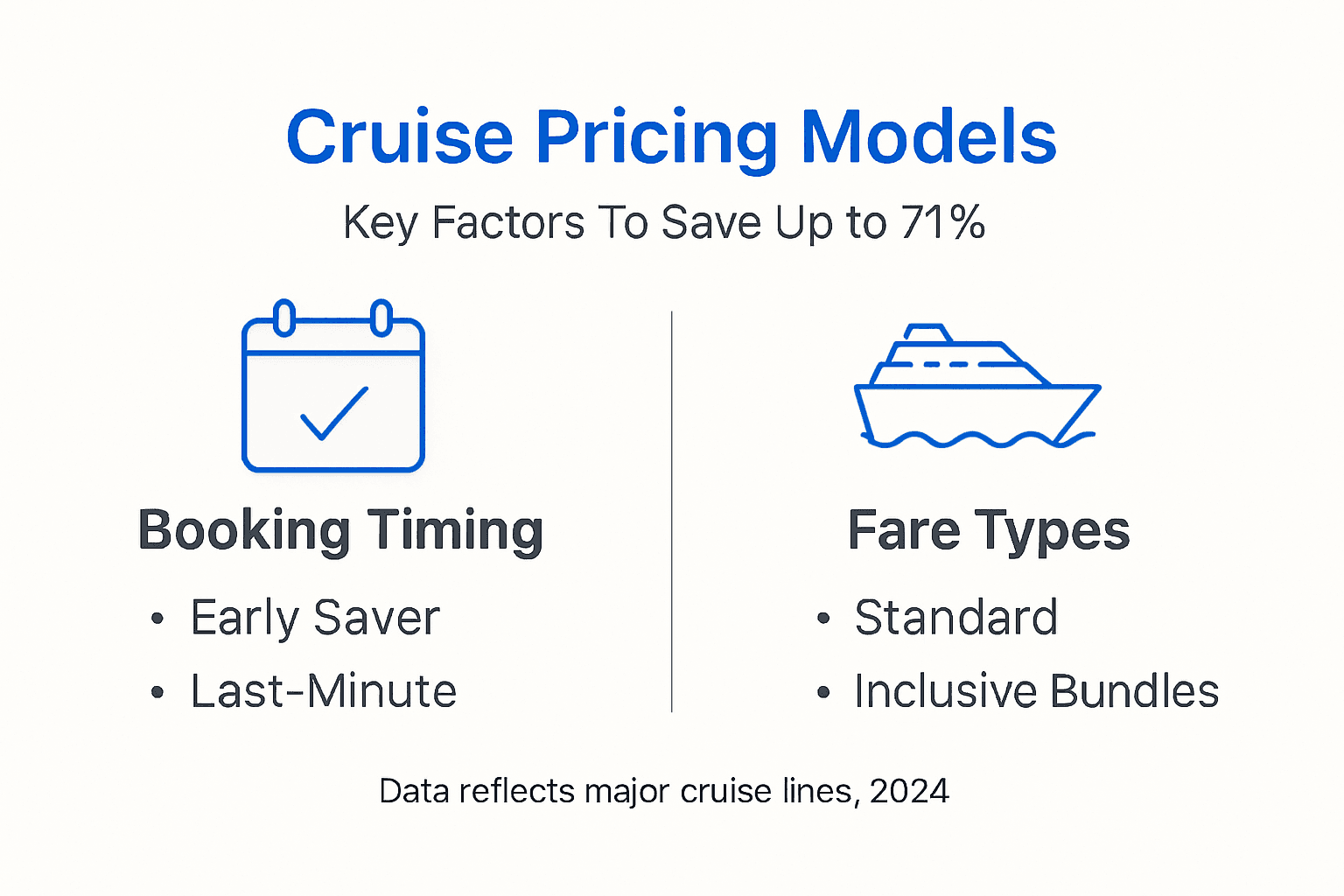
Several core factors drive these price fluctuations. Booking timing ranks as the most influential variable, with prices typically starting lower at itinerary release and climbing as departure approaches and cabins fill. Seasonal demand patterns, special events at ports, and even day of week bookings occur all influence what you’ll pay. Cabin category availability matters too since cruise lines strategically release inventory in waves to create urgency and maximize revenue per sailing.
The industry has undergone a fundamental shift away from last minute discount strategies. Princess Cruises eliminated last minute discounts and sets lowest prices at booking release, pioneering a model where the earliest bookers secure the best deals. This change reflects sophisticated revenue management systems that prioritize filling ships early to reduce marketing costs and improve cash flow, fundamentally altering how savvy travelers should approach cruise fare explained strategies.
Key principles of modern cruise pricing include:
- Prices generally trend upward from initial release to departure date
- Early booking windows of 12 to 18 months out typically offer optimal pricing
- Revenue management algorithms continuously adjust fares based on booking pace
- Promotional waves create temporary price dips but rarely beat initial release rates
- Understanding how cruise deals are priced helps you identify genuine value
Understanding Early Booking Incentives
Cruise lines have strategically restructured their pricing to reward travelers who commit early, fundamentally changing the game for deal hunters. When itineraries first release, typically 18 to 24 months before sailing, cruise lines price aggressively low to generate momentum and gauge demand. As bookings accumulate and cabins fill, algorithms automatically raise prices to capture maximum revenue from later bookers willing to pay premium rates for diminishing inventory.
This early bird approach benefits cruise lines in multiple ways. Advance bookings provide predictable cash flow, reduce marketing expenses, and allow better operational planning for provisioning and staffing. For passengers, the trade off is clear: commit early and save substantially, or wait and risk paying significantly more. Princess Cruises rewards early bookers by eliminating last minute discounts and raising prices after initial release, making the traditional strategy of waiting for desperation deals obsolete.
The death of last minute discounting stems from improved analytics that help cruise lines fill ships without resorting to fire sales. Rather than holding empty cabins and slashing prices weeks before departure, modern revenue management targets optimal occupancy through gradual price escalation. This means procrastinators now face the highest fares and limited cabin selection rather than scoring deals, completely inverting the old bargain hunting playbook that favored last minute cruise deals approaches.
Consider these early booking advantages:
- Widest selection of cabin categories and locations at initial release
- Lowest base fares before demand driven price increases kick in
- Access to early booking perks like onboard credits or free upgrades
- Flexibility to monitor prices and leverage guarantee programs
- Traditional benefits of last minute cruises no longer apply under new pricing models
Pro Tip: Set calendar reminders for when your preferred cruise line releases new itineraries, typically 18 to 24 months in advance. Booking within the first few weeks of availability consistently yields the lowest possible fares before demand algorithms trigger price increases.
Best Price Guarantee Programs
Best Price Guarantee programs address the primary concern preventing travelers from booking early: the fear of finding a lower price later. These consumer protection policies promise to match or beat any lower fare you discover within a specified window after booking, typically removing the risk from committing early. The mechanics are straightforward but the details matter significantly when determining whether you qualify for compensation.
Princess Cruises offers 72 hour Best Price Guarantee with 110% compensation on price difference, setting an industry standard for protecting early bookers. If you find your exact cruise for less within 72 hours of booking, the cruise line refunds 110% of the difference as onboard credit or applies it toward an upgrade. This generous compensation structure incentivizes travelers to book immediately at itinerary release rather than playing wait and see games that might backfire.
Important conditions and exclusions apply to guarantee eligibility. The lower price must be for an identical sailing, cabin category, and passenger count through authorized sales channels. Promotions combining third party discounts, group rates, or special resident fares typically don’t qualify. The guarantee window starts at your booking confirmation time, not when you first researched prices, making timing your purchase strategically important. Most programs also require you to book directly with the cruise line rather than through third party agencies.
Key benefits of guarantee programs include:
- Eliminates price anxiety associated with early booking decisions
- Provides financial protection during the most volatile pricing window
- Encourages immediate action when you find attractive itineraries
- Shifts risk from consumer to cruise line during initial booking surge
- Understanding cruise deal pricing helps maximize guarantee value
These programs fundamentally change booking psychology by removing the primary downside of early commitment while preserving all the upside of locking in low initial rates and premium cabin selection.
Guest Based Pricing Variations
Cruise pricing structures treat the first two guests in a cabin differently from additional passengers, creating significant savings opportunities for families and groups. The published per person rate typically assumes double occupancy, with cruise lines calculating revenue primarily from these first two guests. Third and fourth passengers receive substantially discounted fares because they generate incremental revenue in already sold cabin space, requiring minimal additional operational cost beyond food and amenities.
Princess Cruises offers reduced fares for third and fourth guests, significantly lowering per person cost for families, making group travel dramatically more affordable than booking separate cabins. The savings can reach 50% to 75% off the standard double occupancy rate for additional guests. This pricing structure makes cruising exceptionally competitive with land based family vacations when you maximize cabin occupancy rather than spreading your party across multiple rooms.

| Passenger Position | Typical Fare Structure | Average Savings |
|---|---|---|
| First Guest | Full published rate | Baseline |
| Second Guest | Full published rate | None |
| Third Guest | 50% to 75% discount | $400 to $800 per cruise |
| Fourth Guest | 50% to 75% discount | $400 to $800 per cruise |
Understanding guest based pricing helps families budget accurately and compare true vacation costs. When you see advertised per person rates, remember these assume double occupancy. Adding your third and fourth family members costs far less than doubling up on cabins would, making family cruise booking sites especially valuable for comparing real total costs rather than misleading baseline rates.
Consider these planning implications:
- Always request quotes for your actual party size before comparing cruise options
- Quad occupancy cabins deliver best per person value for families with kids
- Solo travelers face supplements rather than discounts, paying 150% to 200% of double rate
- Different cruise fare types affect how guest discounts apply
Pro Tip: When comparing cruise options for families, calculate total trip cost for your entire party rather than focusing on advertised per person rates. The third and fourth guest discounts often make seemingly expensive cruises more affordable than cheaper alternatives that don’t discount additional passengers as aggressively.
Inclusive Pricing Models and Bundles
Traditional cruise pricing separated base fare from discretionary expenses like specialty dining, drinks, WiFi, excursions, and gratuities, creating bill shock when passengers tallied their total vacation cost. Inclusive pricing models bundle these popular amenities into upfront rates, providing cost certainty and simplifying value comparisons across cruise lines. This transparency helps travelers budget accurately and reduces the anxiety of tracking spending throughout their voyage.
Oceania Cruises’ Simply More pricing bundles excursions, drinks, WiFi, and gratuities for simplified upfront cost, eliminating the nickel and dime experience that frustrated passengers under traditional models. The all inclusive approach appeals particularly to first time cruisers who struggle to estimate discretionary spending and prefer knowing their total investment before departure. While bundled fares appear higher initially, the comprehensive inclusions often deliver better value than base fare plus itemized charges.
Comparing bundled versus unbundled pricing requires calculating total vacation cost rather than just headline rates. A $2,000 per person bundled cruise including drinks, WiFi, gratuities, and excursions might actually cost less than a $1,400 base fare cruise where you’ll spend $800+ on those same amenities. The bundled model also influences behavior, encouraging passengers to fully utilize included amenities rather than self rationing to control costs.
Common bundled inclusions across cruise lines:
- Specialty dining at premium restaurants throughout the ship
- Unlimited beverage packages covering alcohol, sodas, and specialty coffee
- High speed WiFi for staying connected during the voyage
- Shore excursions at ports of call
- Prepaid gratuities for service staff
Inclusive pricing benefits travelers preferring predictable all in costs and those who would purchase these amenities separately anyway. Budget conscious passengers who rarely drink alcohol or prefer independent port exploration might find better value with traditional unbundled fares. Understanding various cruise price factors helps determine which pricing model fits your travel style and budget.
Multi Channel Sales and Dynamic Pricing
Cruise inventory reaches consumers through multiple sales channels including direct bookings through cruise line websites, online travel agencies (OTAs), traditional brick and mortar travel agents, and specialty cruise agencies. Each channel employs distinct pricing strategies and promotional tactics, creating price variation for identical sailings. Understanding how these channels interact with dynamic pricing helps you identify the best deals and avoid overpaying through less competitive sources.
Direct cruise line bookings typically offer transparency and access to exclusive promotions unavailable through third parties. OTAs leverage volume purchasing to negotiate rates and add their own competitive pricing, sometimes beating direct prices but often excluding you from cruise line loyalty benefits and guarantee programs. Traditional agents provide personalized service and may access consortium rates not available to individual consumers. Dynamic pricing varies by sales channel: direct, OTAs, agencies, each influencing final prices and revenue management.
The complexity of multi channel revenue management creates both opportunities and challenges. Cruise lines must balance maximizing revenue across all distribution partners while maintaining rate integrity and avoiding channel conflict. This balancing act sometimes produces situations where the same cruise costs differently depending on where you look, rewarding comparison shopping but requiring vigilance to ensure you qualify for important protections like Best Price Guarantees.
| Sales Channel | Pricing Characteristics | Key Advantages | Potential Limitations |
|---|---|---|---|
| Direct Cruise Line | Transparent, guarantee eligible | Full loyalty benefits, guarantee protection | May not always offer lowest rate |
| Online Travel Agencies | Competitive, comparison friendly | Easy comparison shopping, occasional exclusive deals | May void cruise line guarantees |
| Traditional Agents | Personalized, consortium access | Expert guidance, possible group rates | Service fees may apply |
| Specialty Cruise Agencies | Niche expertise, added perks | Industry connections, value adds | Limited to represented cruise lines |
Navigating channel complexity:
- Compare prices across at least three channels before booking
- Verify guarantee program eligibility if booking through third parties
- Consider total value including perks and loyalty benefits, not just base fare
- Understanding why cruise deals change across channels helps optimize your search
Smart shoppers check direct cruise line pricing first to establish baseline rates and guarantee terms, then compare against OTA and agent offerings to ensure they’re capturing genuine discounts rather than paying inflated rates through less competitive channels.
Technology and Price Prediction Tools
Advanced analytics and machine learning now power tools that help consumers predict cruise price movements and identify optimal booking windows. These technologies analyze historical pricing patterns, booking velocity, seasonal trends, and inventory levels to forecast whether fares will rise or fall. While no prediction system guarantees accuracy, data driven insights significantly improve your odds of booking at or near the lowest possible price point.
Price tracking services monitor your selected cruises continuously, sending alerts when fares drop below your target threshold or when prediction models indicate prices will soon increase. Some platforms claim prediction accuracy enabling savings up to 71% compared to booking randomly without data guidance. These tools work best when combined with understanding of cruise pricing fundamentals covered earlier, using algorithms to time your purchase within the early booking window where the best deals concentrate.
Implementing technology assisted booking strategies:
- Set price alerts for cruises 12 to 18 months before departure when initial pricing appears
- Review prediction confidence scores to gauge reliability of forecast price movements
- Combine alerts with Best Price Guarantee programs for maximum protection
- Act quickly when tools signal optimal booking windows since prices can change within hours
- Resources like why track cruise prices explain tracking methodology
The tools work by aggregating massive datasets across sailing dates, routes, cruise lines, and cabin categories to identify patterns invisible to individual shoppers. Machine learning models detect when specific cruises deviate from historical norms, flagging unusual deals or warning about imminent price increases. This data driven approach removes emotion and guesswork from timing decisions that significantly impact your total vacation cost.
Pro Tip: Set up price tracking immediately when you identify cruises you’re seriously considering, even if you’re not ready to book. The historical price data you’ll accumulate over weeks helps you recognize genuine deals versus normal fluctuation when you’re ready to commit. Combine tracking alerts with Best Price Guarantee protection to capture the lowest possible fare with insurance against subsequent drops.
Common Misconceptions About Cruise Pricing
Many travelers still operate under outdated assumptions about cruise pricing that lead to poor booking decisions and missed savings. The most persistent myth claims last minute deals always offer the deepest discounts, causing procrastinators to wait until close to sailing dates expecting desperate fire sales. Last minute bookings are rarely cheapest due to removal of deep discounts and rising demand. Modern revenue management eliminated this strategy, leaving late bookers paying premium rates for limited inventory.
Another common misbelief suggests third party agencies always beat direct cruise line pricing. While agencies occasionally offer competitive rates, booking through unauthorized channels often disqualifies you from Best Price Guarantee programs and cruise line loyalty benefits. The few dollars saved on base fare may cost you hundreds in lost protections and perks, making direct booking the smarter choice despite slightly higher headline rates.
Many assume all passengers pay identical fares regardless of booking timing or party composition. In reality, pricing varies wildly based on when you book, how many guests share your cabin, and which sales channel you use. Two families on the same cruise might pay 50% different per person rates based solely on these factors, making education about pricing mechanics directly valuable to your wallet.
Correcting these misconceptions:
- Early booking nearly always beats waiting for last minute deals under current pricing models
- Third party “bargains” may void valuable protections worth more than small fare savings
- Guest based pricing means families must compare total costs, not just advertised per person rates
- Best Price Guarantee terms require careful reading to understand eligibility requirements
- Promotional pricing often applies only to new bookings, not existing reservations
Making evidence based decisions requires questioning inherited wisdom about cruise deals that made sense under old pricing structures but leads you astray today. Understanding how the industry actually prices inventory now, rather than how it worked five or ten years ago, directly translates to hundreds of dollars in savings per booking.
Conclusion: Applying Pricing Knowledge to Your Booking
Mastering cruise pricing models empowers you to book confidently, knowing you’ve secured genuine value rather than wondering whether you overpaid. The fundamental shift toward rewarding early commitment means your optimal strategy involves monitoring new itinerary releases, acting quickly when attractive options appear, and leveraging guarantee programs to protect against subsequent price drops. This proactive approach replaces the outdated wait and hope strategy that now consistently results in higher costs.
Successful booking combines timing, research, and strategic use of available protections. Start monitoring prices 12 to 18 months before your preferred travel dates, set up tracking alerts, and prepare to move quickly when prediction tools signal optimal buying windows. Always verify your actual party size pricing to capture group discounts, compare bundled versus unbundled options based on your spending habits, and book directly with cruise lines when possible to maintain guarantee eligibility.
Your step by step booking strategy:
- Identify your preferred itinerary, travel dates, and cruise line 12 to 18 months in advance
- Set up price tracking alerts and monitor initial release pricing closely
- Compare total costs across cabin categories considering guest based discounts for your party size
- Book directly with the cruise line during the first few weeks of itinerary availability
- Document your booking details and monitor prices for 72 hours to leverage Best Price Guarantees if rates drop
- Review cruise booking tips for additional optimization strategies
The cruise industry’s pricing evolution favors informed, decisive travelers who understand how modern revenue management works. Your knowledge of dynamic pricing, early booking incentives, guarantee programs, and guest based fares positions you to consistently capture savings that elude passengers still following outdated bargain hunting playbooks.
Explore Top Cruise Booking Platforms for 2025
Now that you understand cruise pricing mechanics, finding the right platform to search, compare, and book becomes your next priority. Modern booking platforms simplify the complex process of evaluating hundreds of cruise options across multiple lines, dates, and itineraries. The best cruise booking platforms offer real time pricing, transparent comparison tools, and seamless booking experiences designed for today’s digital travelers.
Whether you’re planning a family vacation requiring careful cost analysis or booking your first cruise and need guidance navigating options, specialized family cruise booking sites provide curated experiences that match your specific needs. Start exploring available cruises and put your new pricing knowledge to work immediately by visiting platforms that make finding and booking cruise deals straightforward and stress free.
FAQ
What is the best time to book a cruise to get the lowest price?
Book when cruise lines release new itineraries, typically 12 to 18 months before departure. Early booking windows offer the lowest base fares before demand algorithms trigger price increases as cabins fill.
How does the Best Price Guarantee protect me when booking a cruise?
The guarantee matches any lower price you find within 72 hours of booking and provides 110% of the difference as onboard credit. This protection eliminates risk from booking early when prices are lowest.
Are there discounts for families or groups booking multiple guests in the same cabin?
Yes, cruise lines heavily discount third and fourth passengers, often 50% to 75% off standard rates. These savings make quad occupancy cabins extremely cost effective for families compared to booking multiple rooms.
Can I rely on third party travel agencies to always offer the best cruise price?
No, third party bookings often disqualify you from Best Price Guarantee programs that require direct cruise line purchases. Small fare savings through agencies may cost you more valuable protections and loyalty benefits.
Recommended
Related reading
6 Best Cruise Destinations 2026 for Smart First-Time Travelers
Discover the 6 best cruise destinations 2026 with expert tips for tech-savvy first-time travelers, including personalized advice for easier cruise booking.
Cruise Package Explained: Stress-Free Vacation Booking
Cruise package means bundled travel with accommodations, meals, entertainment, excursions. Learn the types, inclusions, pros, costs, and mistakes to avoid.
7 Smart Ways to Save on Cruises for Modern Travelers
Discover 7 smart ways to save on cruises with easy, practical tips designed for today’s digital cruise travelers. Learn to maximize value and minimize costs.