Cruise Tipping Guidelines Explained: 2026 Complete Guide

Cruise gratuities are daily service charges automatically added to your onboard account, and they are a fixed cost of cruising, not an optional extra. For 2026, daily rates vary depending on your cruise line and cabin category. Here is what you need to know before you board:
- Carnival Cruise Line: daily service charges for standard staterooms and suites vary by category.
- Royal Caribbean: daily service charges for standard cabins and suites vary by category.
- Norwegian Cruise Line: daily service charges applied for standard and suite categories.
- Princess Cruises: daily charges differ by cabin category.
- Luxury lines (Regent Seven Seas, Silversea, Seabourn): gratuities are bundled into the fare
- Specialty dining, bar, and spa purchases generally carry an additional automatic gratuity charge on top of the daily rate.
- Gratuities are technically voluntary but widely considered standard and critical to crew income
- Extra cash tips for porters, butlers, and exceptional service are optional but appreciated
For a couple on a 7-night sailing, automatic gratuities accumulate to a notable amount on Carnival, Royal Caribbean, and Norwegian. Budget for that before you book.
What are cruise ship gratuities and why do they exist?
Cruise gratuities go by several names: daily service charge, crew appreciation, hotel service charge, auto-gratuity. They all mean the same thing. A fixed daily amount per person is added to your onboard account and pooled by the cruise line, which then distributes it among service crew.
This system replaced individual cash tipping, which became unworkable as ships grew larger and dining options multiplied. When passengers had assigned tables and one cabin steward for a week, handing out envelopes on the last night made sense. On a ship carrying 5,000 guests with flexible dining and a dozen restaurant options, it does not. The pooled model covers crew members you interact with directly and those you never see.
The compensation structure is what makes gratuities non-negotiable in practice. Crew in housekeeping and food and beverage roles earn base wages that are sometimes only a few dollars a day, with tips representing as much as 95% of their take-home pay. That is not a cruise-industry quirk. It mirrors the tipping economy in American restaurants, just formalized into a mandatory daily charge rather than a discretionary gesture.
Gratuities are technically voluntary on most mainstream lines. You can walk to guest services and have them removed. But the practical reality is that the charge is how the people cleaning your cabin and serving your dinner get paid. Removing it does not protest cruise line pricing. It cuts crew income.
How much do cruise gratuities cost by line and cabin type?
Rates vary by cruise line, cabin category, and even embarkation date. The table below reflects 2026 rates for the four major mainstream lines.
| Cruise Line | Standard Stateroom | Suite / Premium Category |
|---|---|---|
| Carnival Cruise Line | $17.00/day | $19.00/day |
| Royal Caribbean | $18.50/day | $21.00/day |
| Princess Cruises | $18.00/day | $19.00–$20.00/day |
| Norwegian Cruise Line | $20.00/day | $25.00/day (Haven/Suites) |
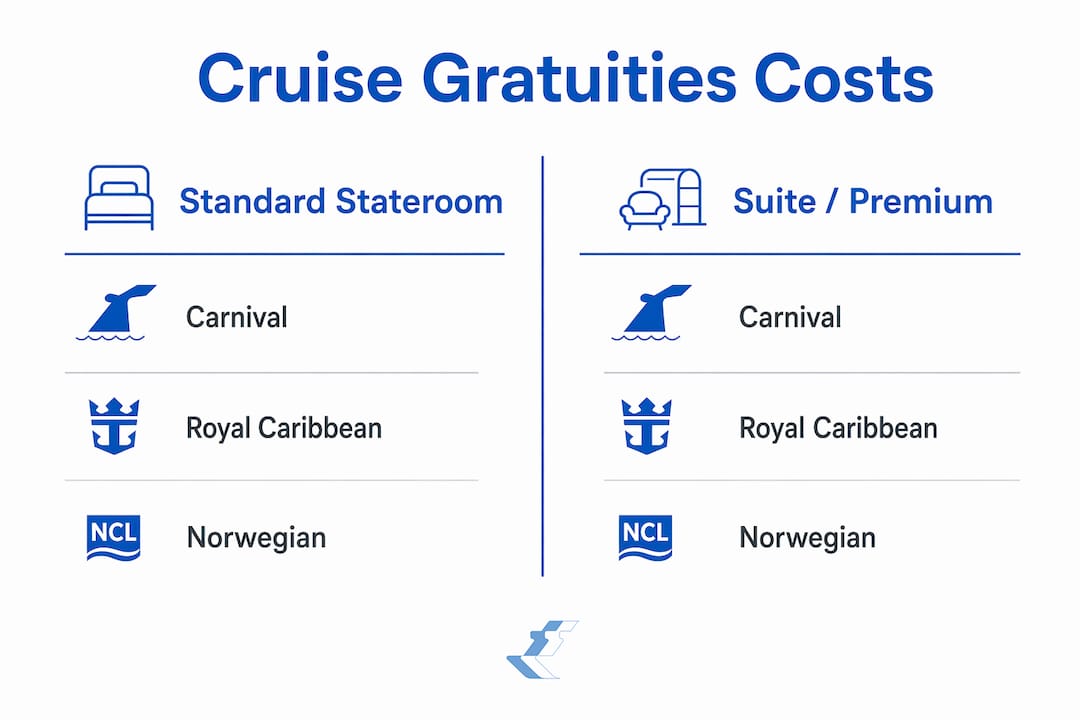
Suite guests pay more on every mainstream line because they receive more personalized service, often including a dedicated butler and concierge. Norwegian’s Haven surcharge is the steepest in the industry at $25 per person per day, reflecting the all-inclusive nature of that ship-within-a-ship experience.
Luxury lines handle gratuities differently. Regent Seven Seas, Silversea, Seabourn, and Azamara build them into the fare entirely. You will not see a daily gratuity line on your bill. That said, spa services on most luxury lines still carry their own separate charge, so check the fine print before assuming everything is covered.
Children’s policies differ by line. Carnival exempts guests under 2; Norwegian exempts those under 3. Royal Caribbean and Celebrity apply the full adult rate regardless of age. On a 7-night Royal Caribbean sailing with two adults and one toddler, that adds $129.50 to your gratuity total compared to the same family on Carnival. It is a meaningful difference worth knowing at booking.
Cruise lines adjust rates periodically. Multiple major lines raised rates in early 2026, including Carnival’s April 2 increase and Princess’s March 8 adjustment. Always verify the current rate on the line’s official FAQ page before finalizing your budget.
How are cruise gratuities paid?
Most travelers encounter gratuities one of two ways: charges that accumulate daily on their onboard account, or a lump sum prepaid before sailing. The total cost is identical either way. The difference is timing and convenience.

Prepaying gratuities locks in the current daily rate. If a cruise line raises its rate between your booking date and your sail date, you pay the lower rate you locked in. Given that multiple lines raised rates in 2026, this is not a hypothetical risk. Prepaying also simplifies your onboard budget: your daily account activity reflects only discretionary spending like drinks and specialty dining, making it easier to track what you are actually spending. No surprise on the final bill.
Paying onboard means the daily charge accumulates automatically. You do not need to do anything. The full total appears on your final statement at disembarkation. For travelers with cash flow considerations, spreading the cost across the voyage rather than paying upfront may be preferable.
Beyond the daily cabin charge, several additional automatic gratuities apply:
- Specialty dining: 18–20% automatically added (20% on Carnival, Norwegian, Princess, and Celebrity; 18% on Royal Caribbean)
- Bar beverages: 18–20% added to every drink purchase or beverage package
- Spa and salon services: 18–20% added at checkout
- Room service: 18% on most lines; free on Royal Caribbean for most items
A common mistake: many travelers see a tip line on their bar or spa receipt and add extra, not realizing an automatic gratuity is already included. Check the receipt before writing in an additional amount. Double-tipping on receipts is one of the most frequent and unnecessary cruise expenses.
Cash tips remain the right choice for porters at the terminal and shore excursion guides. Porters expect roughly $2–$5 per bag; they are port-authority employees at most US homeports and receive no share of onboard gratuity pools. Shore excursion guides typically receive $3–$5 per person for a half-day tour, more for a full day.
Who actually receives your cruise gratuities?
The pooled gratuity system covers a much wider range of crew than most travelers realize. Your cabin steward and dinner server are the visible faces of service, but they represent only a fraction of the people whose work shapes your experience.

Automatic gratuities are distributed among cabin stewards, dining room servers, assistant servers, buffet staff, behind-the-scenes kitchen workers, laundry crew, and housekeeping staff. Norwegian has stated explicitly that its Daily Service Charge is shared with behind-the-scenes support staff including table bussers and maître d’s. Carnival divides its gratuities among the dining team, housekeeping, culinary, hotel services, and key guest service positions.
The income stakes are real. For service crew in housekeeping and food and beverage roles, tips can represent as much as 95% of take-home pay, because base wages are sometimes only a few dollars a day. A cabin steward’s total monthly compensation, including gratuities, ranges from $650 to $1,150. An assistant waiter earns $900–$2,200 per month all-in. These are not supplemental earnings. They are the primary income.
Not every crew member participates in the tip pool. Ship officers, captains, the hotel director, executive chefs, and entertainment staff receive salaries instead. A cruise ship captain earns $100,000–$150,000 annually. Tipping officers is considered awkward and unnecessary. The gratuity pool is specifically for service-oriented crew whose compensation model is built around it.
Pro Tip: If a crew member delivers genuinely exceptional service, a written compliment to the hotel director carries real weight. Positive feedback can go on their record and lead to bonuses or promotion, which matters more than cash for their long-term career.
Adjusting gratuities, opting out, and tipping etiquette
Every major mainstream line allows you to modify automatic gratuities at guest services before disembarkation. None allow changes after you leave the ship. Norwegian’s Daily Service Charge is technically fully refundable onboard, making it the most flexible of the major lines on this point. Carnival, Royal Caribbean, and Princess all permit adjustments at the guest services or guest relations desk while you are still aboard.
Removing gratuities entirely because of a bad experience is a last resort, not a first response. The charge pools across dozens of crew members, most of whom had no involvement in whatever went wrong. The better path is to raise specific service concerns at guest services while still onboard so the line can address them directly.
For additional cash tipping beyond the automatic charge, here is what the etiquette actually looks like:
- Cabin steward: $2–$3 per person per day for a 7-night cruise, given on the last evening
- Butler (suite guests): $5–$10 per night in cash, handed directly on the last morning
- Dining room server (exceptional service): $10–$20 at the cruise’s end for a regular table relationship
- Porters at embarkation: $2–$5 per bag, cash, before they take your luggage
- Shore excursion guide: $5–$10 per person for a half-day tour; more for a full day
- Kids’ club counselors: Not expected, but $5–$10 per child per day is a welcome gesture if your kids spent real hours there
Pro Tip: Hand out personal cash tips on the last evening of the cruise, not the final morning. Disembarkation day is chaotic for everyone, crew included, and finding the specific steward or server you want to thank becomes genuinely difficult in the rush.
Do not tip the captain, ship officers, the cruise director, or the hotel director. They receive salaries, and the gesture lands awkwardly rather than warmly. Piano bar performers are the exception: a cash tip there is both expected and appreciated, especially if you are making song requests.
One nuance worth knowing: on luxury lines like Seabourn and Silversea where gratuities are included in the fare, the no-tipping culture is genuine. Crew are trained to politely decline cash tips. On mainstream lines, a cash tip to your cabin steward at voyage end goes directly to that individual beyond the pooled charge, and it is always welcomed when the service has been exceptional.
How to budget for cruise gratuities before you book
Gratuities are a fixed cost of cruising, not a variable you can skip. Build them into your cruise budget the same way you would factor in airfare or hotel nights. The math is straightforward once you have three numbers: daily rate, number of nights, and number of paying guests.
A family of four on a 7-night Carnival cruise in standard staterooms pays $17 × 7 × 4 = $476 in automatic daily gratuities. On Norwegian in the same configuration (standard staterooms), that rises to $20 × 7 × 4 = $560. Add the specialty dining and bar auto-charges on top, and the total gratuity budget for an active week can easily reach $600–$700 for a family. That is before any optional cash tips.
Pro Tip: Prepay gratuities at booking when rates are rising. Carnival’s April 2026 rate increase meant travelers who prepaid before that date locked in $16 per day instead of $17. On a 14-night sailing for two, that is a $28 saving for doing nothing except booking early.
A few more budgeting considerations:
- Solo travelers pay the full per-person daily rate even though they are already absorbing a single supplement on the cabin fare. A 7-night Norwegian sailing in a standard stateroom adds $140 in daily gratuities for one person. Factor that in at the cabin-selection stage.
- Specialty dining: Two specialty dinners at $80 each generates a $32 gratuity charge at 20% on most lines. If you plan to dine at specialty restaurants several times, those charges add up fast.
- Beverage packages: The 18–20% gratuity is charged on the package price at purchase, so it is a one-time charge rather than a per-drink accumulation. Check whether the package price already includes the gratuity before buying.
- Luxury lines: When comparing fares, always add the estimated gratuity total to mainstream line prices before comparing against an all-inclusive luxury fare. A 7-night sailing for two generates $252–$308 in automatic gratuities on mainstream lines. That gap closes the price difference with luxury lines more than most travelers expect.
For a deeper look at what is and is not covered in your cruise fare, the cruise fare breakdown on ChooseCruise walks through exactly which services and staff are included in the base price versus what carries additional charges. And if you want to lock in the best rate before gratuities rise again, ChooseCruise’s real-time price tracking lets you monitor fare and gratuity changes across lines before you commit.
Plan your next cruise with ChooseCruise
Knowing the tipping rules is one part of planning a cruise well. Finding the right ship, itinerary, and price is the other. ChooseCruise makes that part faster: AI-powered recommendations, real-time price alerts, and a clean booking process that cuts through the noise of dozens of cruise lines and thousands of sailings.
Whether you are comparing a Carnival 7-night with a Norwegian Haven sailing or trying to decide whether a luxury all-inclusive fare is worth the premium once gratuities are factored in, find and compare cruise deals on ChooseCruise and see the full cost picture before you book.
Key Takeaways
Cruise gratuities are a fixed, per-person daily charge that funds crew compensation and must be treated as a required cruise cost, not an optional extra.
| Point | Details |
|---|---|
| Daily rates vary by line | Rates range from $17 per person per day on Carnival to $25 per person per day for Norwegian Haven suites in 2026. |
| Suites cost more | Suite guests pay higher daily rates on every mainstream line, reflecting more personalized service. |
| Prepaying locks your rate | Prepaying before sailing locks in the current rate and protects against mid-year increases. |
| Extra charges stack up | Bar, spa, and specialty dining carry a separate 18–20% automatic gratuity on top of the daily cabin charge. |
| Crew income depends on tips | For service crew, gratuities can represent as much as 95% of take-home pay, making removal a direct pay cut. |
Recommended
Related reading
6 Best Cruise Destinations 2026 for Smart First-Time Travelers
Discover the 6 best cruise destinations 2026 with expert tips for tech-savvy first-time travelers, including personalized advice for easier cruise booking.
Cruise Package Explained: Stress-Free Vacation Booking
Cruise package means bundled travel with accommodations, meals, entertainment, excursions. Learn the types, inclusions, pros, costs, and mistakes to avoid.
7 Smart Ways to Save on Cruises for Modern Travelers
Discover 7 smart ways to save on cruises with easy, practical tips designed for today’s digital cruise travelers. Learn to maximize value and minimize costs.